codejake6 hours ago
We still have a SPARC IPX in production, hosting an antiquated database. The hard drive sounds like grinding metal. I've been trying to get rid of it for years. I succeeded once, but it was brought back from the dead. This thing has been running with the original parts since 1993 to 2026, minus ~1 year of downtime.
Nobody has the root password anymore, but fortunately, it's vulnerable to at least seven remote root sunrpc exploits. We "log in" by running a Python script that pops a root shell.
No, I am not kidding.
Edit: Checked out records: purchased and brought online in 1993.
Edit 2: In response to "why don't you just change the password?". When I asked, I was told they "can't" because they'd "lose access to the database". I didn't ask them to elaborate, because it would have opened a whole new can of horror worms, but I removed it from the Internet (it's on a non-routable, weakly "air gapped" network now).
shrubble5 hours ago
QEMU has a SPARC CPU emulator; it might be possible to run the operating system and database in a VM on regular x86-64 hardware.
greatquux3 hours ago
You absolutely can run 32bit Solaris in qemu SPARC emulation. 64bit is not there yet unfortunately. But definitely dd this and get it virtualized!
EvanAnderson3 hours ago
A BlueSCSI[0] might be an interesting thing to add if you want to alleviate the hard disk sound.
ThrowawayR25 hours ago
Out of morbid curiosity, is there a recovery plan for when it inevitably experiences a hardware failure?
jeffrallen4 hours ago
Buy parts from RS and fix it, silly.
linksnapzz6 hours ago
This box needs an official retirement ceremony when the database is migrated.
jdboyd6 hours ago
If you get a root shell once, why not change the root password then?
codejake6 hours ago
Great, obvious question!
The answer I got: "we can't. We'll lose access to the database". I did not ask for elaboration, but it is not routable to/from the Internet.
adrianmonk5 hours ago
You can just add a second line to /etc/passwd with a different username but the same numerical uid. Like this:
altroot:x:0:0:Alternative Root User:/:/bin/sh
We used to do this all the time for users who needed root access to their own workstation. It allowed us to avoid telling them the common root password used on all the machines in the organization.
In your case, doing this might be beneficial in case there is a network problem because you'll have a way to log in as root locally.
bink5 hours ago
Back in the day we would've just added our IP to the .rhosts file and no password would be required at all!
It does have me thinking about what versions of SSH would run on such an old OS. I'm sure there were versions available at one time... and since it's vulnerable to remote exploit anyways the version wouldn't really matter.
shrubble3 hours ago
SSH v1 protocol would work; but it’s still considered insecure by SSH clients of the last two decades :-)
orthogonal_cube5 hours ago
Seems as though the process of changing the password on their end may not be as straightforward. Or they’re just worried that misconfiguring it may prevent them from getting connected again.
In any case, as long as it’s not directly routable to the internet and there’s a plan to phase it out, probably nothing to get worked up about.
I hope the sound of the drive isn’t particularly bothersome. It’s rather impressive to still be working.
gknoy6 hours ago
> We "log in" by running a Python script that pops a root shell.
I'm surprised that when you do this, you can't then set the root password. (Also, holy cow. What a durable machine.)
numpad05 hours ago
dump that disk asap!!!!!
epakai3 hours ago
I got a IPX in 2022 and restored it. I was a bit lucky and mine was an ex-IBM unit that came with the Weitek SPARC POWER μP processor (80 MHz) upgrade.
It makes for a pretty good project box as one of the smaller SPARC machines. Lots of documentation from hobbyists, Sun's own service manuals, and OpenBSD/NetBSD. Flash SCSI disk replacements are much easier to get your hands on now (I used a ZuluSCSI).
I've kept a log with photos: https://drislock.org/pkb/machines/perfect.html#a-little-lunc...
It seems to have been part of IBM's IBM-IPT Tester system. Hostnames were interesting: flower, owl, piglet, diamond, hotlips. I didn't get any interesting data though since this system relied on network resources.
bradleyy5 hours ago
Everybody hating on the IPX, but I have so much nostalgia. Yes, my friends who ran a repair shop kept employed fixing them, like transmission shops survive on minivan transmissions.
That era hardware (although I ended up with a fair bit of experience on the whole Sun 3/4 lines)... I had just gotten out of the Army, didn't know what I was going to be when I grew up, and the future was so terrifying but bright.
It's a good thing that I don't horde (except cars, that's a problem), because I'd have racks of these things. Named after Star Trek characters, not because I care about it, but because that was the naming convention at one of my first "real jobs".
IDK, maybe nobody else thinks this way, but I'm really glad to see someone fixing one.
pureagave4 hours ago
I had one on my desk and eventually a collection of Sparc 2, 10's and a V in my garage. I miss the keyboard and Sun OS 4, the Trinitron display and working on difficult engineering problems on those machines.
cesaref2 hours ago
Nobody misses the terrible optical mouse with the blue metal mouse mat though! You are right, the keyboards were great.
smackeyacky2 hours ago
I do. At my first job it looked so technical! Sure they were a bit rubbish but at least you didn’t have to pick all the hair and gank off the rollers and balls all the time.
jasoneckert7 hours ago
God that machine was terrible - underpowered and undercooled, which led to frequent overheating and component failures. When I first started at Sun, they put one of those on my desk as a joke on my first day (it was quickly replaced so that I could get some real work done).
mzi6 hours ago
At work in the 90s we gave tons of old Sparcstation 10s away. They rapidly replaced all IPX and IPS at the computer clubs around Sweden. One Volvo was destined for Luleå and was really weighted down with a trunk full of pizza boxes.
foobiekr6 hours ago
I managed a lab of them. I _hated them_. They were unreliable, slow, and just absolutely miserable because they created endless complaints.
We were rolling out labs of Windows machines. Except for the lack of terminal, they were better on every single axis for the common university lab use cases - mostly netscape/mosaic and applications..
I also managed NeXT slabs and cubes; they were vastly better than the sun boxes because we had installed HDDs in the cubes and extra memory. The only problem with them was the absolutely terrible, shit behavior when users accidentally browsed the AFS root...
The only positive thing I can say about those Sun boxes is that _one_ behavior was better than NeXT. With NeXT, students would pull the power on them after wating four or five minutes of the beachball due to AFS I/O.
jeffbee5 hours ago
A younger person who only knows the comparative merits of Windows, macOS, and Linux in this decade probably cannot imagine the relief felt by people when they were finally able to move their technical applications off unix boxes onto Windows NT workstations. The situation was so bad, the computers cost so much and worked so poorly, a Dell with a Pentium Pro was like a miracle, at the time.
chihuahua2 hours ago
I don't have any nostalgia for old machines, I understand the 5- or 6-figure price tags were ridiculous, but I'm curious - in what way did Unix machines back then work poorly?
qingcharles29 minutes ago
For the price, these Sun workstations were slow as hell to me. X was horribly laggy. The UI put me off Unix GUIs for a decade. The mouse was meh.
I love the industrial design of these pizza boxes, though. I didn't mind when I was running them headless as IRC servers or web hosts.
shrubble3 hours ago
Only some people who were around at that time welcomed Windows NT; others decried the various failings of Microsoft…
foobiekr3 hours ago
There is an irony that Wine is the most stable linux ABI for GUI applications in 2026.
anthk2 hours ago
That means nothing when everything it's either RHEL bound, Ubuntu LTS or docker containers among standalone services written in Go which are everywhere.
Serious GUI software will be written in QT5/6 where the jump wasn't as bad as qt4->5. Portability matters and now even more. Software will run in any OS and several times faster than Electron.
sixothree5 hours ago
I remember a lab with diskless systems where your disk quota was smaller than the kernel panic dump. So basically if you crashed a machine your account was instantly filled up and basically nothing would work. I believe it affected mail as well. Fun times.
jjgreen6 hours ago
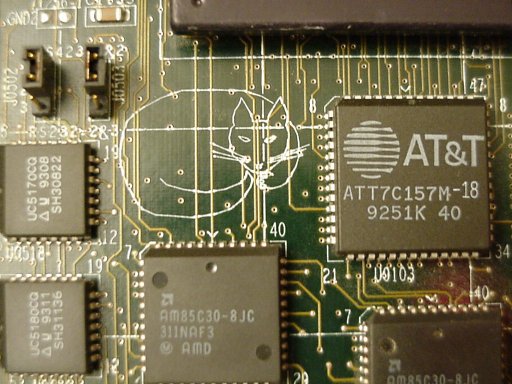
But, but ... that cat
seanhunter6 hours ago
Totally terrible. ONe place I worked we all had sparcs and the first thing that happened whenever anyone left is there would be this mad shuffle where everyone nicked everyone else's computer with the IPX being the prize for whoever wasn't there at the time or the new joiner. So I had the IPX for a while, even just using it as an x client for a remote build server it was horrible.
MengerSponge6 hours ago
Classic day 1 hazing, the Wimp Lo: https://www.youtube.com/watch?v=d696t3yALAY
jeffbee6 hours ago
Yeah it was a real piece of junk, but I guess there's no accounting for nostalgia. People also like to restore the SGI Indy, easily the worst machine that SGI ever shipped.
At one point decades ago there were a lot of these IPXs and their SCSI accessories on eBay and they were a decent source of project boxes because you could use the power supply and stick your project where the hard drive was supposed to be, with the wires coming out the SCSI port. It looks like the model 411 is still $30 or so on eBay but there are few.
JSR_FDED3 hours ago
The Indy was awesome. One client had 400 of them, as long as you didn’t take the lowest RAM entry level model they were excellent. Hardware was reliable, graphical desktop better than MacOS today, and very low support burden.
justin662 hours ago
So true. Keep in mind, OP said it was the worst machine SGI shipped, not the worst machine Sun shipped. SGI's worst machine could be fixed by adding some RAM. Sun's worst machines were completely unsalvageable.
Keyframe6 hours ago
Hey, don't trash talk Indy like that. It has.. well, it is Web! and has VRML.. and it's your only option for N64 devkit. So, there's that. Overall you're right though. Entry level machine. I have one in working order, rarely has use next to Indigo2 MAX impact. I do have one Sparc, haven't been booted in ages. I have to check whether it's IPX or Classic. I'm even afraid to boot it up.
technothrasher3 hours ago
I went through replacing the NVRAM on an old Sun 3/80 about a year ago. Amusing adventure, and then fun to get to use BOOTP again to network boot. Lots of nostalgia. Boy how I had forgotten how primitive it was to use SunOS 4.1.3.
outofmyshed5 hours ago
Not the greatest UNIX workstation in the world, but we had rooms full of them at my uni and I learned how to Internet on them. Still a lot of love for these.
pureagave4 hours ago
Great keyboard, great display, great OS. It was fast enough and a great terminal to bigger Sparcs if you needed it.
Doches5 hours ago
Oh, man; I got my hands on a (dead) one of these when I was a freshman in college (2004) and instead of trying to restore it my friends and I gutted it and used it as an original Xbox case mod. It was pretty satisfying to show up at LAN parties with what looked like a Solaris box and watch people boggle when we played Halo on it...
Findecanoran hour ago
I've been wanting to get one for a PC mITX case mod. I love Sun's design language and the IPX cases are cute.
I have got a Sun Type 5 keyboard though. I brought it to a mechanical keyboard meetup once, only to show it off because it is so pretty. Not the best key feel though, but I've got nothing to use it with.
xenadu023 hours ago
Making the default MAC address and machine serial number depend entirely on the NVRAM/RTC battery is... a choice. You'd think they would have used some fusible links to burn the original values into the hardware to fall back on if the battery died.
rasz2 hours ago
Nobody burns in MAC addresses. MAC is usually stored on eeprom. Either in BIOS or small i2c one on the NIC. Storing it in the nvram means you save $0.1 BOM, dont have to partition your bios chip and serialization becomes cheaper and faster. Its not like losing one is a problem, just bang a random number with Sun prefix and you will be statistically fine.
jrnichols5 hours ago
This was a lot of fun to see, especially part 3 where it boots up. Us older guys (me, anyway) still find joy in seeing these old machines we learned our skills on being restored like this.
Thanks for posting this one. good find.
alexhormozi6 hours ago
oh yeah that's interesting