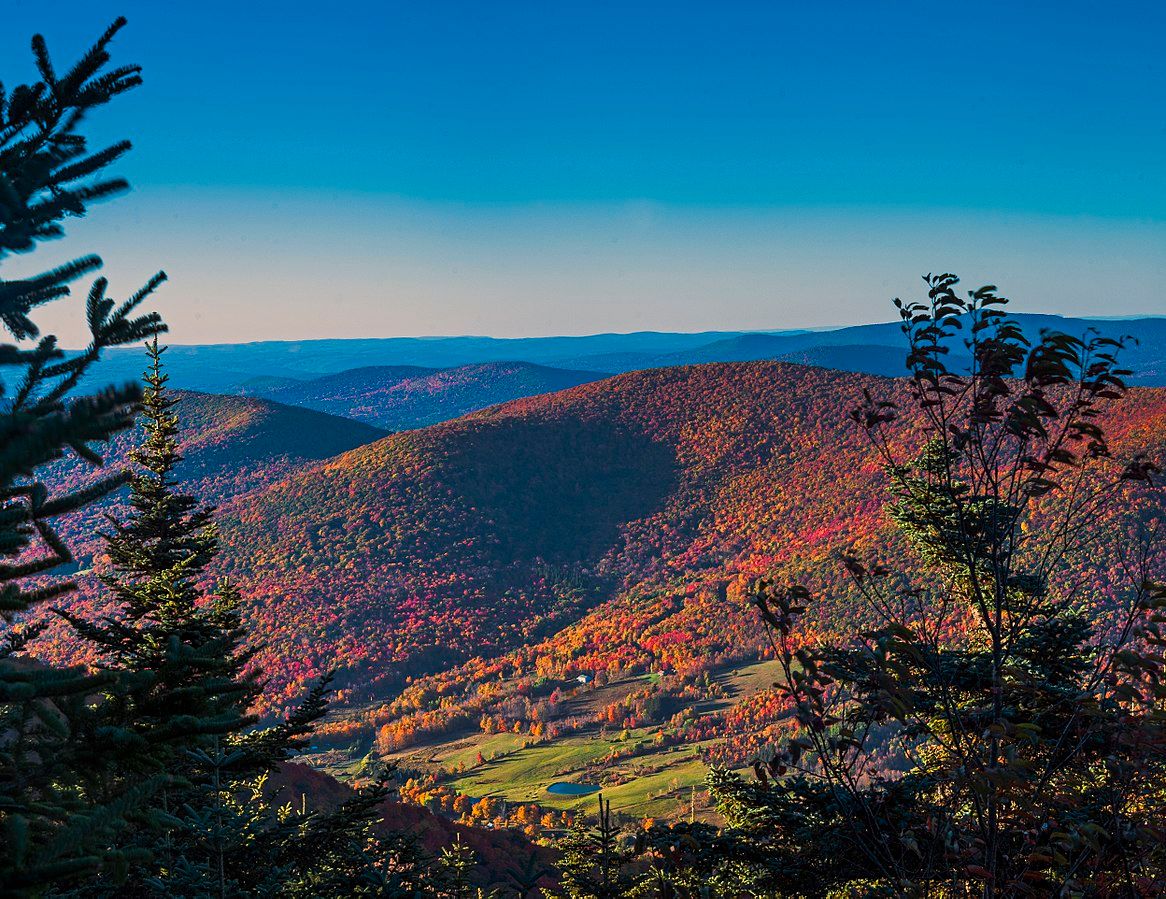
shagie15 hours ago
And if you want to hike it, you've got the International Appalachian Trail... https://iat-sia.org/the-trail/
almog12 hours ago
If you want to section hike it, its entire North American part is covered by the Eastern Continental Trail (ECT), which some people (very few, as in a tiny fraction of all A.T. thruhikers) thruhike it in a single calendar year.
biomcgary13 hours ago
This explains the Scotch-Irish settling in Appalachia. It felt like home, but without the overbearing Brits nearby.
librasteve13 hours ago
surely you mean overbearing English, old man?
oncallthrow12 hours ago
No, we just found Nicola sturgeon’s hacker news account
clickety_clack12 hours ago
Ya, the Scotch-Irish were the Brits doing the overbearing in Ireland.
physicsguy3 hours ago
Let’s also not forget that the Irish lords that the Anglo-Irish supplanted were themselves the descendants of Normans.
[deleted]2 hours agocollapsed
SubiculumCode7 hours ago
Appalachian Fae, mysterious lights, all the stories. Love it.
esseph12 hours ago
A lot also settled in the farmlands of Western Kentucky and brought sheep farming along with them, which is how it emerged as a very intense (mutton, pork, chicken, beef) bbq region.
sollewitt7 hours ago
On the island of Ireland those people _are_ the overbearing Brits.
jjulius7 hours ago
If ya think that's neat, go check out the idea behind Baja BC - that huge chunks of British Columbia and Alaska, as well as portions of Washington, were once down by Baja Mexico.
https://ui.adsabs.harvard.edu/abs/2015AGUFM.T13A2979G/abstra...
sbuttgereit6 hours ago
Nick Zentner, a geology lecturer at Central Washington University, takes a particular subject and does a relatively deep, discussion oriented, dive into it over the course of 26 sub-topics... his "A to Z" series. In these he does a couple streamed shows a week and includes links to relevant papers and resources. At the end of each session is a viewer Q&A for those watching live. Almost an online continuing education course....
He did "Baja-BC A to Z" 3 years ago:
https://www.nickzentner.com/#/baja-bc-a-to-z/
With the associated reading list: https://www.geology.cwu.edu/facstaff/nick/gBAJA/
Currently he's about halfway through another "A to Z" called "Alaska A to Z" which covers some of that same territory
https://www.nickzentner.com/#/livestream-series-26-episodes/
And the so-far-posted reading list: https://www.geology.cwu.edu/facstaff/nick/gALASKA/
Of central importance to the first half of the current Alaska series is recent paper by geologist Robert S. Hildebrand titled: "The enigmatic Tintina–Rocky Mountain Trench fault:a hidden solution to the BajaBC controversy?"
What's great about these series is that he'll get a number of the geologists writing these papers involved in one way or another. Either contributing interviews or talks specifically for the video series, or like in the case of this Hildebrand centric work in the current series, Hildebrand himself is watching the stream and participating in the live chat with the other viewers, answer questions and the like.
sakopov13 hours ago
According to this study from 2005 [1] the Appalachians are eroding 6 meters per 1 million years while the rivers are incising 30-100 meters per same time period. So they're technically still becoming more rugged.
[1] https://web.archive.org/web/20250326213947/https://www.geoti...
al_borland14 hours ago
I visited Scotland last year. They bring this up a lot on tours. Some of the distilleries also bought land in the Appalachian region to grow trees to make future whiskey casks.
mauvehaus8 hours ago
In Scotland, surely they're concerned with the future supply of whisky casks, not whiskey casks.
Also, AIUI, because bourbon has to be aged in new white oak barrels, you find a lot of former bourbon barrels aging distilled spirits all throughout the world, Scotland included.
al_borland8 hours ago
> whisky casks, not whiskey casks.
Interesting, I just looked up the details on this[0]. I’m surprised they didn’t hammer that home as well. I thought maybe you were just being pedantic at first, but that’s a good call out. I did make sure to say cask instead of barrel, as a barrel is just one size option for a cask.
They did talk about the rules of scotch vs bourbon and how some of that supply chain works for reuse.
[0] https://www.scotchwhiskyexperience.co.uk/about/about-whisky/...
fsckboy6 hours ago
glancing at that map, an interesting (to an American mostly just cuz we think we know our own geography) trivia factoid came to mind:
Q: Where in the US are you closest to Africa?
I'll explain the answer key at the bottom so you don't see them sooo readily if you want to think about it... but whatevs
an entirely different interesting factoid, the Catskill Mountains in NY State, which seem to be part of the Appalachian Range, are in fact not mountains at all. What appear to be mountains is actually erosion of a high plateau, leaving mountainous appearing hills https://static1.thetravelimages.com/wordpress/wp-content/upl... (they are however connected to the Appalachians, they just aren't mountains)
.
Wrong Answer: adirolf
A: eniam
I wrote the words backward
prennert2 hours ago
I would file this under blogspam, given the length of the article, the atrocious oversimplifying, highly compressed map and the number of ads.
If you are interested in the geology of Scotland, there are excellent books available, including "Land of Mountain and Flood: The Geology and Landforms of Scotland". I am sure good books about the Appalachians and the Atlas are available, too.
tengwar215 hours ago
I'm finding it difficult to believe that map relates to the title. It's not showing just the Scottish Highlands (roughly speaking the north-west half of Scotland), but the whole of Scotland, Ireland and Wales, plus about half of England, including the famously flat Lincolnshire fens.
zimpenfish12 hours ago
> including the famously flat Lincolnshire fens.
I think they might have gotten flatter in the intervening 200M+ years.
nephihaha15 hours ago
Didn't know about the Atlas, but I knew northern Scotland and Nova Scotia shared a lot of geology.
Tagbert15 hours ago
The southern end of the Atlas, the Anti-Atlas range, is from the same formation as the Appalachans. The rest of the Atlas came from a different (later?) event.
[deleted]7 hours agocollapsed
trgn15 hours ago
atlas remain very high though. so what's different there that they're not eroded?
wahern15 hours ago
I've been nerd sniped. Per Wikipedia, https://en.wikipedia.org/wiki/Atlas_Mountains
> In the Paleogene and Neogene Periods (~66 million to ~1.8 million years ago), the mountain chains that today constitute the Atlas were uplifted, as the land masses of Europe and Africa collided at the southern end of the Iberian Peninsula.
But it also notes,
> The Anti-Atlas Mountains are believed to have originally been formed as part of the Alleghenian orogeny. These mountains were formed when Africa and America collided
Anti-Atlas? If we jump over to the Anti-Atlas article we see,
> In some contexts, the Anti-Atlas is considered separate from the Atlas Mountains system, as the prefix "anti" (i.e. opposite) implies.
and
> The summits of the Anti-Atlas reach average heights of 2,500–2,700 m (8,200–8,900 ft),
So in addition to subsequent events, the portion of the Atlas originally formed with the Appalachian is geologically distinguishable from the other portions of the Atlas chain, and actually significantly lower than the parts of the chain formed later, though not as low as the Appalachians.
adolph14 hours ago
The Scottish Highlands are also significant to contemporary understanding of geology.
brcmthrowaway15 hours ago
Where do the himalayas fit in all this?
voxleone13 hours ago
The Himalayas formed because the Indian craton moved exceptionally fast northward (all the way from Antarctica) and collided with Eurasia, one of the fastest sustained plate motions known in geological history.
The collision with Asia began around 50–55 Ma and is still ongoing, which is why the Himalayas are still rising today.
mr_toad10 hours ago
The Himalayan mountains are new kids on the block. The Appalachian ranges pre-date life on land, they pre-date the evolution of vertebrates.
nkrisc15 hours ago
They don’t.
turtlesdown1115 hours ago
They're also mountain ranges formed from the collision of plates? Otherwise, nothing, the timelines of the formation of the Himalayas and the Appalachians are hundreds of millions of years apart.
cranberryturkey12 hours ago
check out local hiking trails on ParkLookup