Geonode21 hours ago
I will die on this hill, because I'm right. Painters put on the first layer in saturated colors like this, then add detail, highlight and shadow. The base layer stuck to the statues, and the rest was washed away.
This whole thing just won't go away because many people are operating outside their area of expertise on this subject.
Painters layer paint, starting with a saturated base color. These archaeologists are simply looking at the paint that was left in the crevices.
griffzhowl21 hours ago
Yes, this is what tfa says, and it's a good point. But tfa also points out that the archaeologists/reconstructionists know that what they're producing differs from the original. The thing is the discipline of reconstruction means that they only use pigments that they have direct evidence of, and this is just the saturated underlayers. The problem is this is seldom explained when the reconstructions are presented to the public
wisty20 hours ago
Reconstructioniats say that they only show th colours they can prove existed.
The article suggests they obstinately do this because they know it creates a spectacle.
I think there's another explanation - if they use their own judgement to fill in the gaps (making the statues more classically beautiful) then everyone will accuse them of making it all up, even if they were to base it on fairly rigorous study of e.g. the colour pallets used in preserved Roman paintings etc.
griffzhowl19 hours ago
Yes, the suggestion that they're trolling goes too far.
However, I did a tiny bit of investigating, and according to this write-up it does seem like Brinkmann presents his work as resembling the originals
https://www.smithsonianmag.com/arts-culture/true-colors-1788...
But they still don't add anything without direct evidence - where there's evidence in later statues for more subtle colouring, they include that.
naravara16 hours ago
I’m reminded of a Reddit thread long ago about a reconstruction of Roman garum by some American scientists. In their paper they conclusively declared that it tasted foul and a Filipino Redditor replied saying “This actually sounds a lot like the fish sauce we use in SE Asia. I wonder if people from a different culinary tradition would find it less off putting or even tasty?” Cue a bunch of Redditors downvoting the poor sap to hell for daring to disagree with the scientists’ assessment of the flavor.
griffzhowl13 hours ago
There might even be a directish connection, one way or the other, between garum and SE Asian fish sauce, since Roman coins have been found in Vietnam.
Can't find the better source on that specifically now but this is a nice article about the Roman trade with India and mentions the coins found in Vietnam and even Korea about half way down
https://www.thecollector.com/why-was-the-roman-indian-ocean-...
On the other hand, it's not implausible that maritime societies come up with their own fish sauce independently
rrrrrrrrrrrryan6 hours ago
Worcestershire sauce is also considered a descendent of the fish sauces from ancient Rome.
eru10 hours ago
I read that what's now 'soy sauce' also started off as a kind of fish sauce originally.
electroglyph16 hours ago
love me some red boat fish sauce!
xg1520 hours ago
The problem is that there is no "missing data" color, so that discipline would default to marble white, which is just as made up as the rest.
I think the Augustus statue is a good example of that: Part of the garish effect comes from the contrast between the painted and nonpainted areas. The marble of his face and harness work well if everything is marble - but in contrast to the strong colors of the rest, the face suddenly seems sickly pale and the harness becomes "skin-colored". The result is a "plastic" or "uncanny valley" effect.
If the entire statue were painted, the effect would be weaker.
fsckboy19 hours ago
>The problem is that there is no "missing data" color
they should use "green screen green" and give you viewing glasses that fill in the colors to your own historical preference (e.g. rose colored? blood-soaked?). then if you point a finger with your "anhistorical" complaints, there will be 3 fingers pointing back at you!
dddgghhbbfblk16 hours ago
They're making it up no matter what they do, since we don't know how these things were originally painted and have no way of knowing. They should just present the reconstructions as interpretations and actually try to do a good job painting them. I agree with the article that what they're doing now is harmful to the public understanding.
20k15 hours ago
I mean, we kind of do though? We could assume that the surviving images of statues showing how they were painted are accurate. If you know the colour of the underlayer, this actually lets you determine exactly what the colouration of the paint on top of that is despite it not being present whatsoever
This gives you a general trend of how brightly underlayed statues tended to be painted afterwards to finish them, and lets you infer how other statues without surviving coloured pictures of them would have appeared based on the likely prevailing style at the time
resize299620 hours ago
That is how scholarship works. It’s like a math proof: they’re interested in proving the base case. If someone else wants to do more speculative work to theorize what a well-painted version would look like, that would be super cool, but it wouldn’t be scholarship.
bjt20 hours ago
And that's a fine standard to maintain when you're writing an academic paper.
When you are instead putting together a museum exhibition intended for the general public, and you observe over and over again that they will interpret your work as representing what the statues actually looked like, it is irresponsible to keep giving them that impression.
It's not an either/or question. They could do some of the statues with just the pure archaeological approach of only using the paints they found in the crevices, and do others in a layered approach that is more speculative but probably closer to how they actually looked. If they did that, this article would not be necessary.
throwthrowuknow17 hours ago
Imagine if we refused to publish any material or exhibit recreations of dinosaurs because the only evidence we have are fossilized skeletons and a few skin texture impressions.
philistine17 hours ago
You've highlighted a very cogent comparison!
Dinosaurs in the first Jurassic Park were fairly well represented considering what we knew in the late 80s. But our knowledge of dinosaurs has grown, with feathers being the most emblematic change. Yet the Jurassic Park movies steadfastly refuse to put feathers on their 3D monsters in the current movies, because viewers do not expect feathers on the T-Rex.
We might be at that point with repainted statues. Museum visitors are now starting to expect the ugly garish colours.
pbhjpbhj16 hours ago
I've not seen the latest Jurassic Park movie, but I've seen a clip with velociraptor's with feathers, and maybe quetzlcoatalus too? Along with colourful skin on eg compsagnathus.
They seem to have moved on a bit, they're balancing audience expectations with latest research, I expect.
autoexec13 hours ago
This guy had feathers and they made him the right size https://jurassicpark.fandom.com/wiki/Oviraptor
shermantanktop20 hours ago
“The reason I’m totally misleading you with a speculative example is because of scholarship.”
No way. When they engage the public, they are not longer exclusively scholars. They responsible for conveying the best truth they can to non-experts.
A journal paper can be misunderstood when the reader lacks the context to interpret it. Out in the public square, that is not the reader’s fault anymore.
vkou18 hours ago
Give the scholars full editorial control of the newspaper the public is getting their news from, and you might get better public understanding of their scholarship.
You generally can't hold someone responsible for what someone else says about them.
WorldMaker19 hours ago
"Dance your PhD" exists for several reasons, but one of them is to point out that the divorce between scholarship and art in some academic fields isn't "required" but an accident of how we separated colleges and how hard it can be to do multi-disciplinary work.
You can do both: prove the base case and reach across the aisle to the art college next door to see if someone is interested in the follow up "creative exercise". You can present both "here's what we can prove" and "here's an extrapolation by a skilled artist of what additional layering/contouring might have done".
marcus_holmes7 hours ago
I would agree with you, but archeologists often classify finds as "for ritual purposes" without any proof or evidence that it was used in a ritual, without specifying what ritual is involved, or how the find would be used in the ritual.
Likewise archeologists will classify finds as tools when they don't have nearly enough knowledge about the craft in question to be able to do this properly (see the extensive mis-classification of weaving swords/beaters as weapons [0], but there are many other cases).
So I'm a little reluctant to cut them some slack and say "this is how scholarship" works when they get all petulant about including colours that we know the ancients had, in ways we know they used them, for this kind of reconstruction.
[0] https://www.academia.edu/67863215/Weapon_or_Weaving_Swords_a...
nobodywillobsrv3 hours ago
I would be curious to know if the treatment of statues in terms of "making them ugly and ridiculous to the point of being insulting" is roughly uniform across the different historical cultures being treated to this "reconstruction" procedure.
i.e. is there evidence that there is comfort in trolling using Roman or Greek vs Assyrian, Nubian etc. Or do they just like to make everything bright and blocky.
underlipton10 hours ago
This is crucial. From the article:
>As a result, we internalized a deep-seated attachment to an unblemished white image of Greek and Roman art. We became, to use David Bachelor’s term, chromophobes. It is this accidental association between Greek and Roman art and pristine white marble, we are told, that accounts for the displeasure we feel when we see the statues restored to color.
And there's indeed been quite a bit of push-back since the story first broke. Unspoken is the reason. Primacy bias is probably a part of it, but what really accounts for the intensity of the attachment to the idea of white marble finishes? I'm sure you can imagine.
>Bond told me that she’d been moved to write her essays when a racist group, Identity Evropa, started putting up posters on college campuses, including Iowa’s, that presented classical white marble statues as emblems of white nationalism. After the publication of her essays, she received a stream of hate messages online. She is not the only classicist who has been targeted by the so-called alt-right. Some white supremacists have been drawn to classical studies out of a desire to affirm what they imagine to be an unblemished lineage of white Western culture extending back to ancient Greece. When they are told that their understanding of classical history is flawed, they often get testy.
https://archive.is/qTreQ#selection-1695.0-1695.693
So, yes, it was important to categorically falsify the notion that the statues, frescoes, etc., were unpainted. Anything that left it open would have been something for the worst sorts of people to latch onto. Now that that's out of the way, possibly even more accurate explanations can be given the time of day, instead of being stuck having to hash out, "Oh, but were they even colored at all?"
xp8420 hours ago
This practice of defining a reconstruction so pedantically as to be wholly unlike real life is just so dumb to me, as a layperson. This would be like “recreating” the experience of using a Commodore 64 but we can’t find any intact copies of the software at all so we provide a fake “OS” that requires the user to write code in ASM only, and say “Ladies and gentlemen, behold our reconstruction! This is what it was like!”
nextaccountic15 hours ago
The alternative is no reconstruction at all on one hand, and adding fake detail on another hand
And if one wants to add fake detail, why should archeologists be involved? Just have AI generate them
mistercheph13 hours ago
The archeologists are already adding fake detail, just at a different level of abstraction. Did they constrain themselves to only painting in the places where they find remnants of pigment? No, otherwise there would be gaps, cracks, and random interruptions of other colors in the painted figures. And there's the guesswork involved in going from spectral analysis (+ other tools) of a pigment sample to an actual paint that could have been plausibly available to the artist.
Reconstruction, (similar to translation) is an art that combines carefuly study of evidence and craftfully filling in gaps and adding in detail where necessary (or leaving details unfilled and ambiguous to communicate the impossibility of total translation or reconstruction!) to present some communicable form of the original that gives the viewer some closer but imperfect access to it.
wang_li14 hours ago
All of those CRT simulators? Largely bullshit, and we still have them around to look at!
mkehrt17 hours ago
A while back the Met in New York had an exhibit of painted reconstructed statues where they let artists make reasonable guesses about what the statues would have looked like. It was pretty fantastic.
Here's an article with one picture I could find, along with a few of the more saturated ones (NSFW artistic nudity): https://www.euronews.com/culture/2022/07/14/visit-the-exhibi...
pqtyw20 hours ago
> have direct evidence of, and this is just the saturated underlayers
Why do they even bother with the "reconstructions" if they know that they are inherently inaccurate, though
bee_rider18 hours ago
Bare marble and garish underlayer reconstructions could be seen as two extreme ends.
The article points out that the garish underlayer reconstructions have (maybe accidentally) been successful at correcting the widely held misperception of bare marble.
There’s also something in… the bare marble reconstruction maps somehow to our idea of sophisticated. Garish underplayed reconstruction, our idea of silly, frivolous, or childish. There were a lot of Greeks, they didn’t all live on one end of that spectrum.
lo_zamoyski15 hours ago
Borderline deception is a bad way to correct inaccurate knowledge.
And frankly, if I wanted to ridicule the ancients and flatter my own age, I could think of no better way than to make the old stuff look bad.
I would much rather have an exhibit that showed the bare marble, then a conservative reconstruction based on what direct evidence merits (to the degree possible, noting that it is not a complete reconstruction), then more liberal but reasonable reconstructions based on indirect evidence.
bee_rider14 hours ago
I think it is hard to say to what extent there actually is even borderline deception. The internet amplifies random and funny things. In this article (which, we should note, is even-handed but leaning skeptical toward the garish reconstructions), it is noted that the images that have spread are the ugliest of the exhibit. If the exhibit tells the full story, and the internet just amplified the silt bits, that’s not deception on the part of the exhibit.
Sharlin18 hours ago
Because exhibitions make money, apparently.
michaelbuckbee20 hours ago
The "garish" statues are more akin to a false color image of mars that shows topography or something. That they're a visual representation of a particular portion of the pigments found and are not supposed to be an accurate recreation of how the statue looked at the time it was created.
lokar19 hours ago
AIUI, false color images of the cosmos are hand tuned to look pretty / interesting / impressive.
amarant17 hours ago
Is there someone who tries to achieve beauty similar to what the original might've looked like?
Would be interesting to see a painted statue that's actually pleasant to look at, rather than these "let's smear this one pigment we found in the armpit all over the face"-style "reconstructions"
kijin20 hours ago
The people who produce dinosaur illustrations don't seem to have as much of a problem with adding all sorts of details (extravagant plumage, wacky colors/patterns, starry eyes and acrobatic postures) that are neither directly supported nor contradicted by available evidence.
griffzhowl19 hours ago
They only started adding feathers after they found evidence of them being feathered, though.
Plus there's zero direct evidence for their colours so there's no option but to use guesswork in these cases.
And a lot of dinosaur reconstructions may be more for edutainment value rather than reflecting a scholarly best-guess. There's no uniform methodology across all these disciplines.
bdr14 hours ago
> Plus there's zero direct evidence for their colours
This is no longer true! Starting with Sinosauropteryx in 2010, paleontologists have identified what they believe to be fossilized melanin-containing organelles. These organelles, called melanosomes, have different shapes depending on which color they produce, and those shapes are preserved well enough to be visible under an electron microscope.
RajT8820 hours ago
We are not dinosaurs, so have rather less skin in the game when it comes to accuracy.
justinator12 hours ago
I have a degree in fine art painting and drawing and that's not correct for oil painting. We would first put on a layer of earth tones, and work from the shadows to the mid tones. Once you got the form correct, you would work on things like adding color, details, and highlights.
In no way would you start with saturated colors. One, they're very expensive, so why would you apply them, just for most to be painted over? Secondly, the more saturated (strong) a color is, the harder it is to paint over. Try painting over a wall painted bright red with literally anything. Paint it over in blue and your blue turns brown. Paint it in yellow and you'll just get red again. That's why we (still) employ a very opaque, white paint to the canvas. Oil paint also becomes more transparent over time, so getting the form right with the earth tone underpainting is crucial for the painting to last hundreds of years.
Perhaps you're thinking of fresco painting? Then, the pigments are added to the medium (plaster) initially, and only very subtle highlights are added afterwards (if at all). This is a very, very difficult technique, and illusions like highlight and shadow are hard to pull off. But the painting over was frowned upon, because it doesn't last nearly as long as the embedded pigment in the plaster (and certainly not after cleaning/restoration). But adding highlight/shadow to a sculpture seems like not the play, as the 3D-ness of a sculpture would imply it brings its own to the table.
Makes more sense just to paint the sculptures the color you wanted them painted, like the (in comparison very contemporary) bust of Nefertiti in the article, which looks excellent. No need for highlight/shadow. I could only see that needed in the face, which would look and act much like makeup.
Geonode10 hours ago
friendly knuckle cracking I wouldn't normally do this, but I did say I'd die on this hill. I'm a tenured professor of art at a major research university. Firstly, maybe I shouldn't have said "saturated," but then again, you wouldn't argue that your earth tones, for example Yellow Ochre or Burnt Sienna aren't saturated in color?
I have a particular expertise in historical scenic painting, (granted, largely for theatrical and ceremonial practice, but that's where we have the oldest examples of painting a fake thing to look real, see trompe l'oeil https://www.britannica.com/art/trompe-loeil )
In these examples, it's clear that the painters started with relatively saturated midtones, and used washes to take the shadows down and clay filled light colors (think gouache) for the highlights: https://masonicheritagecenter.org/backdrops-gallery/
As to the expense of saturated colors, it's the scholars claiming saturated colors, so the expense was made, obviously. But was yellow the final color, when it is the perfect base coat for a two part skin tone using first yellow, and then pink? In the first image in the article, you can see that half of the face is yellow, but that the other half is light colored skin. This exact theatrical layering practice has been used, first yellow, and then pink.
The fourth and eighth images in the article looks extremely similar to the scenic backdrops I've linked above, but one is from the same time period as these statues, and the other is from hundreds of years later. There is a clear similarity in the final work. I believe it's obvious that both painters used dry pigment mixed down to a thin consistency, and used a series of 5 to 7 quick layers to achieve fast, one session results.
This practice doesn't have anything to do with what we call oil painting today, which can be quite laborious and is normally achieved over multiple sessions. These artists would have wanted to knock out a work and get down off the ladder.
Happy to discuss further, all the best.
wileydragonfly10 hours ago
How much of that major research is related to art?
Geonode9 hours ago
Well my team brought in several million dollars this year, but your point is still valid. :)
felipeerias10 hours ago
As the article points out, the more of the original color scheme that has survived, the better the reconstructions look.
Example: https://www.dailyartmagazine.com/wp-content/uploads/2022/09/...
The author suggests that this minimizes the opportunity for mischief, but tbqh it's likely that the ancients were simply much better artists than the people carrying out these reconstructions today.
I'd love to see a modern artist attempt one of these reconstructions using original materials but with greater artistic freedom.
bethekidyouwant10 hours ago
Romans didn’t have oil paints
aylons21 hours ago
The archaeologists know that and say as much in TFA:
"The paints used in the reconstructions are chemically similar to the trace pigments found on parts of the surface of the originals. However, those pigments formed the underlayer of a finished work to which they bear a very conjectural relationship. Imagine a modern historian trying to reconstruct the Mona Lisa on the basis of a few residual pigments here and there on a largely featureless canvas.
How confident could we be that the result accurately reproduces the original?
This point is not actually disputed by supporters of the reconstructions. For example, Cecilie Brøns, who leads a project on ancient polychromy at the Ny Carlsberg Glyptotek in Copenhagen, praises the reconstructions but notes that ‘reconstructions can be difficult to explain to the public – that these are not exact copies, that we can never know exactly how they looked’."
Jakob21 hours ago
Contemporary historic preservation sees itself as the guardian of historical substance. The content of a monument is bound to the preservation of the inherited material.
Georg Dehio’s principle of "conserving, not restoring" is often invoked as a synonym for this self-conception. Old and new need to be clearly separated.
It is a counter-movement to the 18th century historicism which ”destroyed” a lot of old monuments beyond repair.
Personally, I think we went too far on the conservation angle (at least in Germany, not sure about other countries), and should restore a bit more again with the knowledge we have. But much more intelligent people have debated that for centuries, so I guess their answer would be the same like https://askastaffengineer.com/.
golemotron17 hours ago
I'm in the conserving camp. It's more truthful than the narrativization that accompanies attempts to restore. We should remember that we all had a reptilian vision of dinosaurs for decades (centuries?) before the latest feathered view. We would have been better with neither. Just display the bones: what we have. Everything else burdens the public with guesses.
pqtyw20 hours ago
> that these are not exact copies, that we can never know exactly how they looked
Meaning that these "reconstructions" are a pretty pointless and have no real purpose.
alistairSH19 hours ago
Idealy, for me as a layperson who is only going to see these in a museum, I'd love to see a series of pieces...
First, the original, untouched (preserved but not restored?) sculpture.
Second, the reproductions highlighted in the article. With appropriate notations about "these are the base layers, not complete, etc"
And third, a best-guess at what the original could have looked like, based on the first two. Yes, this might be wrong and need to change over time.
JoeAltmaier20 hours ago
They show us what the base layers were, and what pigments of the day looked like.
It may be an academic point. But they are academics.
pqtyw20 hours ago
Well they might as well show the texture of unprocessed marble as well. This is not particularly different.
notahacker19 hours ago
I mean, showing the texture of the underlying stone is how the vast majority of statues from classical antiquity are displayed, and indeed how most pastiches are created.
(and half the objection to the paint jobs comes from the fact we've come to incorrectly associate decorative elements from the classical period with the colours of bare stone)
indoordin0saur17 hours ago
I totally agree with. This is not a reconstruction because the shading, detail and subtler colors are completely left off. It's just a reconstruction of the statue as it would have been in an incomplete state!
marginalia_nu21 hours ago
Yeah, I've likewise always figured the reason these reconstructions ended up looking so awful is because paint is generally applied in layers (even to this day), so what they're likely reconstructing is the primer layer.
Like we know from Roman frescoes[1] and mosaics[2] that they were pretty skilled painters and solving the problem of how to paint something to have more hues than a King's Quest 3 sprite is unlikely to be an unsolvable aesthetic problem.
[edit] Changed from Secret of Monkey Island since that game has too many versions and remakes.
[1] https://upload.wikimedia.org/wikipedia/commons/6/6e/Chiron_i...
[2] https://en.wikipedia.org/wiki/Plato%27s_Academy_mosaic#/medi...
fsloth21 hours ago
"many people are operating outside their area of expertise on this subject."
Exactly. I takes years of really hard work to get good at this stuff. Decades.
I do realize research budgets are not that awesome, but when claims are of aesthetic in nature (explicitly and implicitly) and deal with human craftmanship there should definetly be collaboration with also craftsmen subject experts.
A good example where this was executed really well was the Notre Dame reconstruction (I _guess_). Craftsmen and academic diligence hand in hand.
Not everyones archeological reproduction has such a budget unfortunately.
the_af21 hours ago
> I do realize research budgets are not that awesome, but when claims are of aesthetic in nature (explicitly and implicitly) and deal with human craftmanship there should definetly be collaboration with also craftsmen subject experts.
Do we know for a fact this didn't happen in this case?
fsloth21 hours ago
With the horrible version of the statues?
They just look ... bad.
While photography destroyed academic art almost to extinction, thank heavens it's still trained and you can find practicing artists. Finding good ones might be a bit hard though.
So you could find a _bad_ artist to help you in your reconstruction project.
But finding an incompetent accomplice probably is not in anyones best interest.
So while hiring _anyone who claims to be an artist_ might be procedurally and managerially an approved method, it really is not the outcome anyone actually woudl want to have. So whatever happened here ... it does not count as professional reconstruction.
You don't need to be an art historian or an artist to recognize this.
You just need to compare them to other art from the period and the frescoes, and consider which one you find more appealing. And once you do this, there is a fair chance you will recognize the "good" art feels like an order of magnitude more appealing to you, even if you don't have the training to recognize the exact features that cause this appeal.
jfengel20 hours ago
An awful lot of the things hanging in museums look "bad" to me. I'm not just talking about the easily-mocked contemporary art. I mean things like Medieval paintings with Jesus painted as a baby-sized adult man. Everything before the development of perspective looks like a grade-school cartoon.
I'm sure you're right that reconstructions of painted statues are inaccurate. But I'm not sure that a good-looking reconstruction would be any more authentic. Cultural tastes vary a lot. I suspect that if we ever do get enough data for a valid reconstruction, I won't like it any better.
JumpCrisscross12 hours ago
> An awful lot of the things hanging in museums look "bad" to me
Sure. But if have a chance to visit Pompeii, the author’s argument will land. The Romans made beautiful art. It seems odd that they made beauty everywhere we can find except in the statues we’ve reconstructed.
fsloth16 hours ago
As a reference point to paintings in antique - these portraits from Roman Egypt are quite nice - from around 0 AD.
bsder13 hours ago
> An awful lot of the things hanging in museums look "bad" to me. I'm not just talking about the easily-mocked contemporary art. I mean things like Medieval paintings with Jesus painted as a baby-sized adult man. Everything before the development of perspective looks like a grade-school cartoon.
Perspective wasn't developed! The Greeks and Romans used it just fine, for example.
What was lost was artistic training because there wasn't sufficient economic market for it. As soon as you got sufficient economic incentive, art magically improves again. This is stunningly obvious if you look at Athens and then Pompeii and then Rome and then the Vatican (with the attendant backslide until the Renaissance as you note).
Interesting parallel to modern--will AI cause a huge backslip in art since the economic market for artists is being destroyed?
[deleted]19 hours agocollapsed
the_af21 hours ago
I'm not sure whether they look "bad" is enough justification. The author dismisses the possible explanation "maybe they didn't consider this bad style back then" without any real argument other than "there are other works of art with different styles".
I agree that I, personally, do not consider them painted in a way that is pleasing to me. But is that what the reconstruction project is meant to achieve, i.e. a painting style that is pleasing to current audiences? Or is it about reconstructing the bare minimum that can be asserted with some degree of reliability that is actually supported by the physical evidence?
Again I must ask: do we know decent artists weren't involved in the reconstruction project? Remember, the goal is to use their artistry to achieve scientific results, not just do whatever they find pleasing.
> You just need to compare them to other art from the period and the frescoes, and consider which one you find more appealing
I get this is the most compelling part of the argument TFA is making, but to be honest I don't find it all that compelling. Surely the people involved in the reconstruction considered this, and there's a reason why they still produced these reconstructions, and I don't believe that reason is "they are incompetent or trolling".
eudamoniac20 hours ago
I believe it is basically irresponsible to present the statues with their base layers only. Either extrapolate the aesthetic top layers that might have been there, or just report that the statues were painted without a visual example. Presenting them as poorly as they do contributes to demoralization and a sense of alienation from one's own cultural roots.
the_af15 hours ago
I believe researchers are under pressure not to extrapolate too wildly, unless they can find strong evidence for their extrapolations. In TFA itself they are quoted (very briefly) saying this is not a representation of what the statues actually looked like, it's just the pigments they guaranteed were there.
> Cecilie Brøns, who leads a project on ancient polychromy at the Ny Carlsberg Glyptotek in Copenhagen, praises the reconstructions but notes that ‘reconstructions can be difficult to explain to the public – that these are not exact copies, that we can never know exactly how they looked’.
Consider that had they gone wild with creativity, they would have been criticized for it. Apparently the current overcautious trend is an (over)reaction to previous careless attitudes in archeology.
This is my uninformed take, anyway. I think TFA's author should have engaged more directly with researchers instead of speculating about their motives; the article -- while making some interesting points -- reads a bit snarky/condescending to me. Why not go straight to the source and ask them?
eudamoniac13 hours ago
"This is almost certainly not what it looked like at all, and it's hideous, but I am going to make sure this image is disseminated across the literature and the news (which will make everyone think it was actually hideous but oh well)" is just more irresponsible in my mind than any alternative.
cxvrfr20 hours ago
Perhaps... it's just that they collaborated with experts on publishing coloring books for five year olds due to some reason.
pantalaimon21 hours ago
That's what TFA is saying
> Another may be that they are hampered by conservation doctrines that forbid including any feature in a reconstruction for which there is no direct archaeological evidence. Since underlayers are generally the only element of which traces survive, such doctrines lead to all-underlayer reconstructions, with the overlayers that were obviously originally present excluded for lack of evidence.
hibikir20 hours ago
Not all painters, and not in all cases: See, for instance, grisalle painting. One can then sketch the highlights and shadows first, and then come in with pretty translucent pigments. When the pigment is what is expensive, it can be more economical. We know for sure many a renaissance painting and fresco was done this way, and some of us do it today.
Now, was it possible that, given the pigments available, they were better off just going with the most saturated thing they could possibly have, and then work from there? Absolutely. But the right argument here isn't that "Painters layer paint this way", but that, as the article indicates, they are unlikely to be unsophisticated artists that don't believe shadows and highlights. So the highlighting and the shading must be in the place where we can't see, because we assume they must exist.
Daub5 hours ago
That is certainly how oil painters paint. But painting on absorbent stone is likely very different - more akin to fresco, and would probably not support a very layered approach.
johndhi21 hours ago
Makes sense. This is basically how skilled painters of miniatures (Warhammer) do it.
orthoxerox15 hours ago
Yeah, these reconstructions look like tournament-grade paintjobs.
philistine17 hours ago
I will die on an adjacent hill: when the details had washed away with time leaving behind merely the sturdier and ugly base, people removed the garish base coat cause that thing is uuugggo! Our ancestors were thinking what we're thinking: It looks better white than with only a base.
ActivePattern21 hours ago
I assume you didn't read the article, since that's their exact point...
"Since underlayers are generally the only element of which traces survive, such doctrines lead to all-underlayer reconstructions, with the overlayers that were obviously originally present excluded for lack of evidence."
[deleted]21 hours agocollapsed
boxed21 hours ago
Maybe it's the author of the article? :P
twelvechairs16 hours ago
The other side is lack of colourfast pigments back then. Underlayers would be cheap and colourfast. Top layers would usually be more expensive and deteriorate much more quickly.
rayiner14 hours ago
Thank you. I know nothing about painting, but I bought the original story about the statutes being painted these garish colors.
BurningFrog17 hours ago
Are there really no statues with surviving full paint remnants?
bsder13 hours ago
There aren't even that many of the original statues remaining. A lot of what survived are copies of the originals.
So, we are extrapolating from a very, very, very spotty data set.
adgjlsfhk117 hours ago
No. 2000 years is a long time.
jerf21 hours ago
This would be a great time to use AI, because it is very good at style transfer. Feed it a lot of contemporary painted art, feed it the base-coat version of the sculpture, and ask it to style-transfer the paintings on to the sculpture. You'd likely get something very close, and for once we can use "The computer said it, I'm not responsible for it!" for the power of good, by making it so no human is responsible for the heinous crime of assuming something without historical evidence (no matter how sensible the assumption is).
(And lest someone be inclined to downvote because I'm suggesting an AI, the real sarcastic core of my message is about our faith in computers still being alive and well even after we all have decades of personal experience of them not being omniscient infalliable machines.)
[deleted]20 hours agocollapsed
metalman21 hours ago
looking at it from the absolute simplest of perspectives, money/time/effort, then the notion of a base, or primer layer that seals a surface and provides a non absorbant layer for the much more expensive coulor coat. primer bieng applied by aprentices and the finnish coat applied by specialists who would be very likely be useing ALL of the tricks of the trade to bring a statue to life, but then wejump forward to Bernini and the total lack of paint, which makes it even more likely that there were competing philosophies around statuary, with everything from vegas type full primary coulors put on with a mop, and others that were master paintings done on 3d canvases, and still others who believd in.the purity of the "raw" sculpture
kijin21 hours ago
> then we jump forward to Bernini and the total lack of paint, which makes it even more likely that there were competing philosophies around statuary
Most Greek and Roman statues had lost their paint long before the Renaissance. Early modern artists held up those paintless statues as the ideal form, which is why nobody from Michaelangelo to Bernini even tried to paint their sculptures. Instead, Bernini learned how to make marble itself interact with light to look alive. For centuries afterward, the purity of raw marble became the one true ideology. Diversity in this area collapsed, and took a long time to recover.
Even today, most people who are used to Western classical art will probably agree that marble statues look better without paint. We've been conditioned for generations to believe so. The ugly reproductions of painted statues aren't helping, either.
alterom16 hours ago
>This whole thing just won't go away because many people are operating outside their area of expertise on this subject.
The point the author made in the article is that the reconstructors are well aware of this, and are, in a way, trolling the masses to raise awareness and attract attention to the classical art and museums.
Keeping history alive generally isn't a profitable enterprise.
empath7521 hours ago
Even a middling warhammer miniatures painter would have done a better job of painting these statues than the reconstructions.
mikkupikku21 hours ago
Makes me wonder if they ever used the same sort of gimmicky paint, like paint with mica flakes to make something look metallic.
hibikir19 hours ago
They couldn't use the same paint, if just because for miniature painting we are almost always running acrylics, so it's all plastic binding the pigments. Even a modern oil paint is quite a bit more advanced than what they could do then.
They also had a significant disadvantage in pigment availability. Chances are that there's a whole lot of modern, synthetic pigments among the colors you use regularly. Pyrrole Red is from 1974, for example.
We know that painters were well aware of things like how many good, natural pigments get different outcomes when diluted (go see what happens as you thin ultramarine), so it's not as if they had no technoology. But something like mica vs aluminum vs just gold leaf is a budgetary issue, both today and back then. You will find that good metallics are more expensive and avoid mica. But for an important statue, I suspect they'd take fewer cost cutting shortcuts, just like we can tell in renaissance and medieval art that got to us in relatively good shape. This is the kind of thing some people spend their lives studying.
kijin21 hours ago
They probably used whatever paint was closest in chemical composition to the residue they found on the statue.
mikkupikku20 hours ago
You mean the primer? Why would they use their fancy paint for that?
numlockeda day ago
Good read! The idea that these marvels of artistry were painted like my 10th birthday at the local paint-your-own-pottery store always seemed incongruous, at best.
> Why, then, are the reconstructions so ugly?
> ...may be that they are hampered by conservation doctrines that forbid including any feature in a reconstruction for which there is no direct archaeological evidence. Since underlayers are generally the only element of which traces survive, such doctrines lead to all-underlayer reconstructions, with the overlayers that were obviously originally present excluded for lack of evidence.
That seems plausible -- and somewhat reasonable! To the credit of academics, they seems aware of this (according to the article):
> ‘reconstructions can be difficult to explain to the public – that these are not exact copies, that we can never know exactly how they looked’.
CGMthrowaway21 hours ago
> The idea that these marvels of artistry were painted like my 10th birthday at the local paint-your-own-pottery store always seemed incongruous, at best.
Have you seen medieval art though? https://www.artistcloseup.com/blog/explaining-weird-mediaeva...
The technique is quite different from the "old masters" of later periods that we often think of as fine art.
nyeah20 hours ago
Sure, but medieval European art generally sucked. (Call this a hypothesis if that helps.)
Compare the damn cave paintings of buffalo to most medieval European art. Some of the 10k-year-old stuff is much better observed. Europeans between about 500 and 1300 mostly couldn't paint. I'm sorry about that.
It's just not always taste. Sometimes it's taste. Sometimes people are bad at making art.
YeGoblynQueenne12 hours ago
Well, I mean you find lots of wonky sculptures and reliefs in medieval art but people in Europe still made some really stunning pieces of art, e.g. see The Lady and the Unicorn (https://en.wikipedia.org/wiki/The_Lady_and_the_Unicorn), or the Choir Screen at the Amiens Cathedral (https://en.wikipedia.org/wiki/Amiens_Cathedral#The_Choir_scr....)) and so on. So it's kind of a sweeping generalisation to say that "medieval art generally sucked".
mcmoor7 hours ago
Mmm both of those are from 1400s and OP do limit it to 1300. And that 1300 limit is for good reason. Renaissance is usually dated after 1453 and that's when European art quality exploded. So yeah, those examples instead prove OP's statement.
sudobash118 hours ago
I think that the medieval art article is making a different point. The art there had a style that was dictated by its purpose and the beliefs of the artists.
For example, most of the examples given in that article are illustrations from manuscripts. This was something (as far as I know) that was new in the western world. The idea that books should be illustrated. And being before the printing press was introduced, each illustration (of which there were often many per page) was hand made. This added a substantial amount of time to an already labor-intensive process. And each image was not intended to be a standalone work of art.
Also, some of the other examples are of iconography. That style remains, largely unchanged to this day. If you do an image search for "religious iconography", you will see plenty of examples of sacred art that are not visually realistic but are meant to be metaphorically or spiritually realistic.
red75primean hour ago
It's all good and spiritual, but it seems that they lost some artistic tools like point-projection perspective during non-that-well-documented ages.
nyeah17 hours ago
Sure, but for me the standard isn't whether it's visually realistic. Plenty of good stuff isn't particularly realistic. Traditional Chinese landscapes aren't realistic, but a lot of them are great. David Hockney has a lot of good work that isn't realistic and uses primitive-looking technique. The standard is not realism or which style was used. The standard, for me, is whether the artist was any good at art. Hockney is. (Usually.)
I'm not particularly basing my opinion on the examples in this article. It's easy to see that a lot of surviving European medieval art sucks. Maybe "surviving" is the problem. Maybe the good stuff got all smokey from being displayed and only the leftovers and student paintings, in storage, have survived.
On illustrations, everybody can see the difference between Durer and most medieval stuff. It's not simply style or taste.
ianstormtaylor7 hours ago
So, just to make it clear… you define good art by “whether the artist is any good at art”.
Illuminating…
——
For anyone who’s interested in a slightly more nuanced take on how people in the Middle Ages perceived of “art” — and how different that notion was to how we perceive it today — Forgery, Replica, Fiction by Christopher Wood [1] is a really interesting read.
Here’s the last sentence of the Goodreads summary, which describes the major transition in thinking:
“… Ultimately, as forged replicas lost their value as historical evidence, they found a new identity as the intentionally fictional image-making we have come to understand as art.”
[1]: https://www.goodreads.com/book/show/3921524-forgery-replica-...
Bayart14 hours ago
I won't bother getting into trying to demonstrate Medieval art doesn't "suck", it's not worth dignifying. But you should be aware you might be placing too much emphasis on painting and drawing specifically as opposed to other art forms.
nyeah14 hours ago
Fine, good point. Medieval paintings and drawings suck, but the pottery may have been incredible.
Yeah, why sacrifice dignity by providing a counterexample? Dignity is important.
Ekaros19 hours ago
I have my own take that painting as art peaked long ago. And now we are mostly at similar level to that in middle-ages...
Paintings used to be better, and before that they were worse.
joefourier18 hours ago
If you think medieval artists lacked skill, check out Villard Honnecourt’s sketchbook, especially the insects on folio 7 and Christ in Majesty on 16:
https://www.medievalists.net/2024/12/sketchbook-villard-honn...
Medieval art is very stylised, but the quality of the lines, the details in the clothes, the crispness of the composition, all that requires a lot of skill. Check out Jean Bondol’s work for instance https://artsandculture.google.com/asset/tapisserie-de-l-apoc...
You may not like the style, but being able to produce works like that requires you to be good at art on some level.
nyeah17 hours ago
Ok, but the Honnecourt sketches are kind of strong. Not professional by today's standards, but decent. I'd be happy to have done them--but I'm not an artist. The tapestry can be appreciated, like Klimt's 2-D-ish stuff can be appreciated. The style is fine. It's not fantastic work, I wouldn't hang it up, but it's reasonably accomplished.
In general, though, yes, I think medieval European artists were short on skill compared to artists from Europe in pre-medieval and post-medieval times, and art from other places between ~500 and ~1300. They had some skill, but not as much.
Artists with limited technique are a real thing. Not everything is taste or style.
thaumasiotes17 hours ago
You convinced me that they lack skill.
The clothing does often look good. In folio 16v ( https://www.medievalists.net/wp-content/uploads/2024/12/Vill... ), it's been overdone and appears to be far wrinklier than fabric could support, suggesting that Jesus is embedded in some kind of strange plant.
The faces are terrible in all cases.
In general, perspective is off, anatomy is off, and you get shown things that aren't physically possible.
regentbowerbird11 hours ago
Are you aware there are artistic styles beyond photorealism?
thaumasiotes9 hours ago
Yes, but in that case, as this article argues, you'd expect something that looked good. https://static.wikia.nocookie.net/teentitans/images/e/e3/TTO...
The Honnecourt illustrations strongly suggest that (a) photorealism is the goal, but (b) Honnecourt doesn't know how to draw it. He does things like place a person's right eye at a different angle to the rest of the face than the left eye has. But hey, how likely is it that viewers will notice a malformed human face?
regentbowerbird38 minutes ago
Teen titans as reference xD stop it you're killing me
watwut4 hours ago
The medieval art was better then those cave paintings. Like, common.
> Europeans between about 500 and 1300 mostly couldn't paint.
They could. And they had wide variety of what they painted and how.
Der_Einzige19 hours ago
So were the Japanese better at painting circa the 1700s and 1800s? Because you got a whole lot of paints of, uhhh, octopi…
nyeah19 hours ago
That's hard to call. Both Europe and Japan seemed fine in that time period. Octopi or no octopi.
MyOutfitIsVague15 hours ago
Octopuses or octopodes. Octopi is incorrect.
Der_Einzige14 hours ago
Tell that to wikipedia: https://en.wikipedia.org/wiki/The_Dream_of_the_Fisherman%27s...
(warning, NSFW)
archagon17 hours ago
Utterly bizarre to claim that a diverse group of people within an 800-year period were simply “bad at art.”
nyeah16 hours ago
No need to generalize. Post some clear exceptions. Or if the statement turns out to be "utterly bizarre but correct" I'm fine with that.
archagon16 hours ago
What do you mean by “exceptions”? Who are we, in our own infinitesimal slice of human history, to judge historic taste in art? And is naturalism the be-all, end-all of good taste? If so, we need to throw out the majority of art in the 20th century.
This is a question for an art historian, not some anon on a tech forum. (For what it’s worth, I find Medieval and Renaissance art to be about equally tepid despite the difference in execution. And plenty of people non-ironically enjoy Medieval art despite its supposed deficiencies.)
nyeah16 hours ago
"some anon on a tech forum"
Don't sell yourself short. Post some art from those 800 years that doesn't suck, and I'll change my views.
Sure, there's plenty of crap in 20th century art. I've seen examples of that. But that's a different subject.
archagon16 hours ago
Like I said, I find the majority of European art before 1800 or so to be fairly dull, so I can't really answer this question. The prevailing technique improved remarkably post-Renaissance, and that's enjoyable to an extent, but the same themes get repeated over and over and over again.
If you're looking for art with an impact, the iconography of Andrei Rublev (and other icon painters during this period) is still massively influential in the Russian Orthodox Church today. 600+ years of direct use and inspiration! The lack of naturalism is not a deficiency.
simiones3 hours ago
The problem is not a lack of naturalism, it's obvious mistakes in the way the naturalistic poses are attempted. Many of Rublev's icons have obvious mistakes in the way joints are painted, for example - but not all of them or the exact same thing; it's not a style, it's simply a limitation of his skills. Many later painters who were inspired by him have corrected this mistake, not sought to reproduce it.
Not to mention, Rublev lived at the end of the Medieval period, and well into the Renaissance - the period where painterly skill in Europe was revitalized.
archagon3 hours ago
Again, I’m not sure why it matters. Henri Rousseau couldn’t draw for shit and yet people adore his art. The represented idea and its aesthetic execution are what people mostly respond to, not how realistic a figure’s joints happen to be. (And FWIW, a large number of Renaissance painters clearly have no idea what a female body looks like.)
lo_zamoyski15 hours ago
Your exposure to medieval art must be very limited. I have seen some very magnificent pieces of medieval art personally. And paintings are a small part of what falls under "medieval art". Include those in the category, please.
And there is another element to consider, which is the purpose of the art. Medieval art was not concerned so much with realism, but with the symbolic.
I wonder: do you think Byzantine icons "suck"? I suspect you do.
nyeah14 hours ago
Do you just want to generalize, or do you want to provide a counterexample? Fine either way.
Sharlin18 hours ago
Weell, there's a reason the Renaissance is called "renaissance" and not something else.
Bayart14 hours ago
That reason is self-hype. The Renaissance was dreadful in comparison to the Late Middle Ages and the Early Modern Period in much of Europe.
lo_zamoyski14 hours ago
The Renaissance is really the tail end of the Middle Ages historically, and the name is a bit of propaganda, just like "Enlightenment".
People flatter themselves.
anthk13 hours ago
This: https://en.wikipedia.org/wiki/Libro_de_los_juegos
13th century. Not just the art, but for the content. Truly ahead of its time.
anthk13 hours ago
Go read the Book of the Games from the 1200's and now you'll learn something. The Middle ages were centuries wide. The last centuries had nothing to do, say, with the 5th century.
marcellus2317 hours ago
The medieval period is different from the classical period. There's no reason to compare to medieval art when we have other examples of classical art that we can compare to.
mminer23720 hours ago
Those are a few examples of weird art from hundreds of years of examples, but even then, those aren't super unskilled paintings. Medieval artists still used shading.
[deleted]18 hours agocollapsed
peacebeard15 hours ago
Medieval art isn't comparable to a 10 year old's paint by numbers kit either. As seen in your link, they understood how to use shading for light and shadow for example.
[deleted]18 hours agocollapsed
cgh17 hours ago
You graciously omitted the article’s follow-on conclusion: the public is being gently trolled.
“On the other hand, at a time when trust in the honest intentions of experts is at a low, it may be unwise for experts to troll the public.”
ActivePattern21 hours ago
I still don't understand is why they don't even make an attempt to apply overlayers, when (as the author notes) there is ample secondary evidence that it would be present. It's not like there isn't already some element of inference and "filling in the blanks" when reconstructing how something was painted from the scant traces of paint that survived.
mbo21 hours ago
This is somewhat an unfounded theory of mine and I was hoping if anyone has any insight: but I sense that this is perhaps a construction of Western restoration/preservationist theory. A lot of effort seems to be taken to either preserve original material, not take liberties etc. While touring temples and museums in Japan, I got a sense that restorations were much more aggressive, and less regard was taken to the preservation of material (or building "fabric"), with a greater focus on the use of traditional techniques during restoration.
bueschera day ago
I think the best explanation is that classicists are not makeup artists. I am reminded of reading some classicists' attempt to create garum in the kitchen by making some unpleasant horror of mashed fish or something back in the eighties or nineties. No one ever mentioned in those kinds of write-ups back then that they still make fish sauce in Italy. (I looked for the source I'm thinking of and it's drowned out by more credible modern attempts). There's a tendency the further north you go to think of the classical world as completely lost, discontinuous, and opaque to us, too, which adds to it.
AdmiralAsshat21 hours ago
> I am reminded of reading some classicists' attempt to create garum in the kitchen by making some unpleasant horror of mashed fish or something back in the eighties or nineties. No one ever mentioned in those kinds of write-ups back then that they still make fish sauce in Italy.
A more modern example might be that recently discovered Babylonian Lamb Stew [0]. Most of the scholarly reconstructions of the stew follow the recipe very literally, and the result is, frankly, awful, because ancient readers would probably have made cultural assumptions about certain steps in the recipe. Meanwhile, some internet cooks who take a stab at the same recipe come up with something arguably much better, because they're applying their knowledge as cooks to guess what might have been stated or unstated by the recipe. [1]
Makes you wonder why no one thought to just take a copy of one of the statues to a modern artist and say, "Hey! How would you paint this?" I'm willing to bet that, even now, it would be reasonably close to how an artist 2000 years ago might have approached it.
[0] https://eatshistory.com/the-oldest-recorded-recipe-babylonia...
[1] https://www.tastinghistory.com/recipes/babylonianlambstew
buescher21 hours ago
There's probably a village in Iraq that traditionally makes something that would be recognizable to the ancients even if it uses potatoes now.
Ekaros19 hours ago
I have been reading cookbook from 1767. And mostly you get ingredients and probably not all of them. And sometimes you get amounts. And useful instructions like boil so many times... I have understood that with those really old recipes, the person recording them might at best have been in the same room. But probably was not a chef.
ink_1316 hours ago
Old recipes are more memory cues for experienced cooks than the modern step-by-step guide for amateurs we are used to. They're scanty in detail because they assume quite a lot of existing knowledge.
It's the difference between "a chicken stew flavoured with turmeric and cumin, then rice enough to cook in and fully absorb the broth" and "first, take 500g of boneless skinless chicken thighs..."
thaumasiotes17 hours ago
> I have understood that with those really old recipes, the person recording them might at best have been in the same room. But probably was not a chef.
That's going too far. The person recording them might be the same person who is used to making the food, or might be taking literal dictation from that person.
Knowing how to make food isn't the same skill as knowing how to explain the process in a way that someone who isn't already trained to make the food can follow.
knome21 hours ago
archeologists needing a hand from modern experts reminds me, too, of Janet Stephens.
https://classics.rutgers.edu/the-hair-archaeologist-janet-st...
JoeAltmaier20 hours ago
Huh. That's exactly how you make garum - an unpleasant horror of mashed fish. Refer to Max Miller and his spectacularly successful effort to reproduce Garum in his back yard.
buescher16 hours ago
It's one thing if you make a youtube video starting from already knowing how to make modern fish sauces, and what they're supposed to taste like, and quite another level of horror if you don't. My recollection of the letter or paper or whatever it was was that the person who wrote it was not at all pleased with the result.
There are folks that will insist that we don't know at all what Roman garum really tasted like or everything involved in its preparation, and they're not exactly wrong since Colatura di Alici can only be traced back to the middle ages, but it's also oddly obtuse. I think it was probably like modern fish sauces but Roman garum could have been as different from Colatura and Asian fish sauce as those are from Worcestershire.
emursebrian21 hours ago
Fish sauce is also really popular in southeast Asia and Worcestershire sauce is often made with fermented fish so can also be considered garum adjacent.
marginalia_nu21 hours ago
There's even a case that Ketchup is a distant relative, as it started out as South East Asian oyster sauce, was imported to Europe, turned into fermented mushroom sauce, was exported to the colonies, and finally turned into tomato sauce (though originally sometimes with fish in it).
pcl21 hours ago
Fermented mushroom sauce sounds so much better than ketchup! Tell me more. Does it still exist commercially?
eszed20 hours ago
Yes! Search for "mushroom ketchup", and you'll find various examples for sale. Whatever kinds I've had are nice on bread, and really nice with eggs, but I wouldn't want to eat with chips / fries.
camtarn20 hours ago
You can still sometimes find mushroom ketchup in UK supermarkets. It tastes a bit like Worcester sauce (spicy and 'brown' tasting), but milder as it has no anchovies in it.
bsder12 hours ago
> so much better than ketchup
Careful. What we refer to as "tomato ketchup" has been bowdlerized and degraded by being made shelf stable.
"When Every Ketchup But One Went Extinct" https://www.atlasobscura.com/articles/history-of-heinz-ketch...
buescher21 hours ago
There's speculation that Asian fish sauce came from Greece through the same cultural diffusion processes that brought Greco-Buddhist sculpture as far as Japan.
bgnn15 hours ago
And fermented shrimp paste and fish sauce are a thing in pretty much whole southeast Asia. Garum isn't too different.
Wikipedia: https://en.wikipedia.org/wiki/Shrimp_paste
[deleted]a day agocollapsed
WorldMaker19 hours ago
There was a similar, maybe apocryphal, story recently of academic archaeologists stumped about an ancient tool until a person pulled out a crochet kit to fidget with their hands near the exhibit and it became obvious that it wasn't a lost tool they just hadn't put it in the right context.
buescher18 hours ago
That's the roman dodecahedrons that are a bit more mysterious than that - the "this is for knitting gloves" explanation is a real stretch, and not only because the Romans didn't have knitting.
WorldMaker7 hours ago
My understanding is that while wool knitting may have been a later invention (and that's disputed) and gloves a need for colder climates than the majority of the Roman Empire (assuming just function over fashion, and the Romans didn't seem immune to fashion), the Romans still had some forms of knitting (and/or "nalbinding" if you want to get extremely technical, but knitting seems a useful enough catch all word), it was just mostly knitting of things that weren't wool. One of the related theories I've seen is that the dodecahedrons may have been for knitting gold and surviving gold necklaces with intricate knit patterns do exist. (That theory maybe also helps explain why the dodecahedrons were often found among "jewelry boxes" and gold stashes.)
Also, even if the Roman Empire had wool knitting a lot of it wouldn't have survived archaeological records (textiles rarely do, which is a shame in general, and also arguably why there is so much bias against certain types of textiles in "historical records") and it seems hard to entirely dismiss the Roman Empire from having wool knitting given the extent of the Empire and how deep the history of wool knitting in the British Isles goes, at the very least, to which the Roman Empire had contact and trading.
arrrg21 hours ago
Did he talk to people who make those reconstructions?
Why speculate from that outside perspective when you could talk to people who worked on them and the decisions they made. I think that would be very interesting. As is that‘s completely missing and it feels a bit like aimless speculation and stuff that could be answered by just talking to the people making those reconstructions. My experience is that people doing scientific work love talking about it and all the difficult nuances and trade offs there are.
jtr119 hours ago
The ending of the article left me feeling he had more of an axe to grind here. The mostly unspoken ideological background is that classical art is often appropriated by proponents of Western chauvinism to demonstrate their supposed innate cultural superiority. Poorly painted reconstructions undermine that image, but it does not mean this was done intentionally. I agree that a more neutral observer would have been interested in learning the thought process of those researchers.
marcellus2317 hours ago
> Poorly painted reconstructions undermine that image, but it does not mean this was done intentionally
If I'm understanding you right, you're suggesting the author thinks that researchers are intentionally doing poor constructions to undermine public perception of classical art as part of some sort of culture war? I don't see anything in the article to suggest this
sapphicsnail15 hours ago
> The enormous public interest generated by garish reconstructions is surely because of and not in spite of their ugliness. It is hard to believe that this is entirely accidental. One possibility is that the reconstructors are engaged in a kind of trolling.
It's towards the end of the article. He doesn't directly mention culture war stuff but he does talk about it being "iconoclastic." I think it's a reasonable interpretation of what he was saying.
simiones3 hours ago
That phrase suggests more that the author believes this is done for spectacle, knowing that it will attract attention to the researcher far more than a nice-looking painted statue would. Basically he seems to be accusing these researchers of doing flame-bait for clicks, like those kitchen-top meal TikTok videos designed to get engagement by making people angry.
marcellus2314 hours ago
I don't think it's reasonable. If there's context I'm missing and this guy has written about culture war stuff before, fair enough, but based on this article alone, I'm not seeing any indication of that.
efxhoy16 hours ago
Maybe my brain is oversaturated with culture war nonsense from too much doomscrolling but that’s where my train of thought went too, even if it wasn’t directly implied.
By claiming our ancient predecessors had terrible taste you can make them look like primitive fools, and make our own modernity appear superior in comparison.
When boiled down to culture war brainrot the poor coloring in the reconstructions becomes a woke statement that the brutish patriarchal empires of antiquity have nothing to teach our sophisticated modern selves and that new is good and old is bad. A progressive hit-piece on muh heritage.
Anything you don’t like is a purple haired marxist if you squint hard enough.
Idk why my brain went there. I’m guessing the years of daily exposure to engagement-farming ragebait had something to do with it.
nyeah20 hours ago
I liked the article but this is a very good point.
mistercheph16 hours ago
Whether intentionally or unintentionally, these researchers have cultivated a public perception that the classical statues we admire looked totally ridiculous and were actually hideous. It is difficult to interpret it as unintentional, when the more absurd your reconstruction, the likelier you are to get press attention and get invited to special events at international galleries.
https://journals.openedition.org/techne/2656?lang=en
https://www.smithsonianmag.com/arts-culture/true-colors-1788...
https://www.npr.org/2022/07/12/1109995973/we-know-greek-stat...
https://bigthink.com/high-culture/greek-statues-painted/
https://www.newyorker.com/magazine/2018/10/29/the-myth-of-wh...
https://steemit.com/news/@beowulfoflegend/greek-statues-were...
arrrg16 hours ago
To get closer to an answer to this you should still talk to the people doing the actual work?
I know that many scholars have an uncomfortable relationship to the PR work their research institutions are doing, but they themselves don’t strike me as unapproachable or closed to nuanced discussion. Seems weird to ignore that perspective and wildly speculate from the outside.
mistercheph13 hours ago
Who is inside and who is outside depends on your (subjective) spatial interpretation of the situation.
It could just as well be said that a bunch of scholars disconnected from the culture, history, and technique of fine arts (except as objects of scholarly interest) are wildly speculating from the outside about the nature of the objects, and people interested in these things are starting to ask "Why are these silly things being said about the topic I'm interested in? Are the people behind this pranksters?"
Anyways, if there is a misunderstanding here, which I don't doubt is the case for at least some of the people involved, why can't the discourse be had in public about it? The question has been asked as you suggest...publicly. Polychromic revivalists are free to respond in public, and we can all benefit from hearing the more nuanced perspectives get expressed.
arrrgan hour ago
How do you think public discourse spaces are created? By approaching and talking to people when you write about them! That doesn’t just magically happen …
I merely would have expected some humility when you characterize the work of other scholars from the outside without even talking to them. (Outside here is relative. Whenever you talk about scientific of scholarly work without talking to the people who do the work you are on the outside.)
If those scholars don’t want to talk to you, fair enough, probably no humility needed. If you don’t want to talk to them (which, fair enough, not everyone is cut out or wants to do journalistic work) you better be humble and maximally charitable, though.
rwmja day ago
His final conclusion is terrible and spoils an otherwise excellent article. Unless he has really strong evidence of it, the specialists are very unlikely to be "trolling" the public. They are scientists and conservators doing their best, working away in museum backrooms.
wongarsua day ago
"trolling" in this instance seems to be a nicer way of saying "misleading to create attention". It's hard to deny that "look at how garish these beautiful statures originally looked" created a lot more attention than a theoretical "Roman statues looked pretty nice, but with paint"
It's an unsubstantiated theory, but the author does go out of their way to say that this might not even be objectionable, if it happened at all
smallnix20 hours ago
And an article "experts are trolling public" creates more attention than "experts stick to evidence and aren't artists"
[deleted]15 hours agocollapsed
skybrian21 hours ago
Yes, it’s speculating when it would have been better to do some journalism and ask some experts what they were doing.
chrismatic21 hours ago
Even worse so: Why does he not simply ask these people? What is it with this trend of sneering at expert decisions without even doing the bare minimum of engaging with them?
ericmay21 hours ago
In the case of the humanities, art, or architecture in academia if you disagree with the orthodoxy you might end up labeled something you don’t want to be labeled as, and you don’t get very far.
In architectural design I think it’s rather pronounced. We already know how to design great buildings for the human environment. There ain’t anything new to learn here, so in order to stand out in the field you have to invent some bullshit.
Well, you do that, you create Brutalism or something similarly nonsensical, and in order to defend your creation you have to convince a lot of other academics that no, in fact, buildings that look like bunkers or “clean lines” with “modern materials” are the pinnacle of architecture and design.
And as time has gone on we still go and visit Monet’s Gardens while the rest of the design and art world continues circle jerking to ever more abstract and psychotic designs that measurably make people unhappy.
Not all “experts” in various fields are weighted the same. And in some cases being an expert can show you don’t really know too much.
chrismatic21 hours ago
This is a point well taken, but it also instills a certain incuriosity about expert opinions which is on display in this article.
In fact you can find a question to this very answer with a quick search: https://www.reddit.com/r/AskHistorians/comments/1nfz67t/comm...
Experts are also not a monolithic block. Within architecture and arts you can find many people who agree with your aesthetic preferences.
It is like claiming that there is a "curly-braced" orthodoxy in programming when you just haven't engaged deep with modern varieties.
ijk20 hours ago
Eh, that's overstating the case. There's clearly some aesthetics that are more appealing to more people but for many architectural movements in particular the reason that they look that way is for the way that specific ideological reasons interacted with material constraints and the intended message. Brutalism in particular was intended to be cheap and honest; given the constraints many of these buildings were designed under, it makes sense. There are some quite appealing brutalist buildings; a core tenet of the style was integrating the buildings into the natural landscape, in contrast to the artificial styles that had previously been popular. The post-war shortages limited the available materials, shaping the constraints they were operating under. Raw concrete was honest, cheap, and was allowed to weather naturally.
There's a lot of ugly brutalist buildings, but there's a lot of ugly buildings in every style. At lot of them look cheap because they were supposed to be cheap; to a certain extent looking inexpensive was intended. In some cases the hostile nature of the institutional building was part of the point, conveying strength unstead of offering a pleasant experience, but there's also some quite pleasant brutalist buildings that have a lot of nature integrated into the design.
rdtsc20 hours ago
> They are scientists and conservators doing their best, working away in museum backrooms.
Yesterday’s kids are today’s scientists. You what the most popular archeological student prank is? - It’s for a team to bury a modern piece of pottery in another team’s site. So I am not at all surprised if they wanted to play a few practical jokes on the public’s ignorance.
Trolling here means that they followed the tradition of restoring the items - use just the materials they found on the statues. Well the materials found were the base layers - so that’s what you restore. You don’t go adding shading or fades or iridescent paint because it looks cute. They create art that looks like an 8 year old painted it, then laugh at the public “ooh-ing and ah-ing” over the “beautiful” restorations.
boxed21 hours ago
It could be survival bias trolling: those who accidentally troll get attention, not understanding that they are trolling.
nyeah20 hours ago
Meh. Maybe. Or maybe "click bait" is a better guess than "trolling". Or even maybe he's right, despite writing something "terrible."
1. The professional qualifications of the people doing the actual work should be taken seriously. But the professionals have no control over the people who dictated how the work should be done, or the people who thought out the marketing. I hope this point is clear to engineers.
2. Even if the "trolling" sentiment is both incorrect and "terrible" ... ok. Noted. That doesn't destroy the value of the whole article.
Screed:
Many of us have reached the point where we throw away the baby if we find the slightest imperfection in the bath water. This now includes medicine, values, science, and (at least in the US) our freedom and our functioning society.
We need to grow up. Another example that many modern folks cannot handle is errors in the scientific literature. The scientific literature is incredibly valuable, despite also containing a lot of errors. That's life. Reading the literature is like fixing a car or playing an instrument. It works fine if you know how to use it. We need to grow up and deal.
mopsia day ago
> They are scientists and conservators doing their best
Even if tastes have indeed changed, something that matches our current taste will reproduce the impact of the statues better than a scientifically meticulous and factually accurate depiction that misses the emotional truth.
the_af21 hours ago
> Give them the tools that were available at the time and let them do their best.
The end result would surely look better, but how would we be assured it resembled historical reality?
Do we know for a fact in these reconstructions there is no input whatsoever from artists? I know, for example, that paleo-artists are responsible for the reconstruction of what dinosaurs are currently thought to have looked like, and they are mostly artists that work in collaboration with scientists directing their work. Why do we think this is not the case for the reconstruction of colors of Roman statues?
empath7521 hours ago
> The end result would surely look better, but how would we be assured it resembled historical reality?
You can be fairly sure that no reproduction would literally resemble the reality, _including the existing reconconstructions_, but you can certainly produce a range of possible reconstructions which would have produced the same evidentiary record, and which would be at least inspired by what we know about contemporary taste that we can derive from surviving paintings and the textual record.
the_af20 hours ago
How do you prevent introducing a bias that then becomes what we "know" about how statues were painted? By introducing modern aesthetic sensibilities and present them as plausible, we then reinforce that this is how statues were painted back then, and we don't know.
I think the article is mostly begging the question, and is not particularly rigorous. At most it's appealing to some sort of common sense, and we know how tempting but unreliable common sense can be in science and history.
To me TFA reads mostly as "this reconstruction looks bad, I refuse to believe ancient Romans painted statues like this, therefore it must be an incorrect reconstruction."
bondarchuk20 hours ago
So let's introduce a bias then, who cares? It's not a mortal offense. It would be cool to see statues painted realistically and non-horribly. And as TFA notes we have frescoes, mosaics, encaustic portraits etc.. that could be used as a guideline.
pqtyw20 hours ago
We do have a non insignificant amount of ancient frescoes, mosaics and even a handful of paintings. As the author has pointed out they generally seem much more appealing to modern aesthetic sensibilities. That seems like reasonably strong evidence than whatever thought processing went into making these so called. "reconstructions".
> To me TFA reads mostly as "this reconstruction looks bad, I refuse to believe ancient Romans painted statues like this, therefore it must be an incorrect reconstruction."
Which I agree is not a reasonably view IF we had no other data. Imposing the garrish 5-yeard old colouring book style is no less biased.
the_af15 hours ago
> Imposing the garrish 5-yeard old colouring book style is no less biased.
I don't think they claim this is what the statues actually looked. In fact, the article quotes an expert saying the opposite: "we can never know what they looked like".
These are conservative but incomplete "this is the part we have strong evidence for".
empath7519 hours ago
> How do you prevent introducing a bias that then becomes what we "know" about how statues were painted? By introducing modern aesthetic sensibilities and present them as plausible, we then reinforce that this is how statues were painted back then, and we don't know.
This is just an argument against doing reconstructions at all. Which I am also okay with. It's not a defense of the existing reconstructions because they have the same problem. You don't want to assume additional layers. The existing reconstructions are assuming there were no additional layers. Neither are valid assumptions, but they are both possible. So present multiple possible alternatives without stating that any of them are accurate reconstructions, only that they are constructions which are consistent with the available evidence.
Surely, if one wanted to produce a "reconstruction" of the Venus deMilo, it would have arms. Even if you don't know what the arms would have looked like. And that you would not reconstruct the arms as just straight lines projecting from the stump and would make some attempt to make them realistic and aesthetically pleasing, even if the end result almost certainly does not look much like what the original arms would have looked like, exactly, it would be more like it in spirit than either the statue with stumps or with some sort of vaguely armed shaped cylindrical attachments.
suddenlybananas20 hours ago
What about the paintings of statues from Pompeii cited in the article?
DrewADesign19 hours ago
The two aren’t mutually exclusive.
anonnon21 hours ago
You didn't see all of the thinkpieces from leftwing academics (inlcuding Mark Zuckerberg's sister) making the link between white marble and "white supremacy," and emphasizing polychromy as a means of de-whitening the represented figures? It never quite made sense to me, as even with coloration, the figures still appeared European, though the academics seemed to think the (unsurprising) uncommonness of blonde hair and blue eyes in the recreations was a "win."
watwut3 hours ago
I totally see link between white supremacy and people who get offended over statue colors. Because that group went completely ape-shit over the most mundane articles on the topic.
And for that matter, people who admire Sparta and like, eventually end up doing nazi salutes.
ImHereToVotea day ago
Are our betters malicious or simply morons. A question as old as time.
[deleted]21 hours agocollapsed
mkoubaa20 hours ago
Have you encountered modern art?
mikkupikku21 hours ago
The statues were obviously carved by expert artists but these "specialists" would have us believe they were subsequently painted by half-assed amateurs. It fails the sniff test so badly, that trolling is a reasonable conclusion. You don't put that much effort into making something only then let some unskilled intern ruin it by covering up all your work with a flat coat of primer and leave it at that.
smallnix20 hours ago
Unlike the article, your comment, does not provide evidence beyond "sniff test". The article brings up paintings of statues, which is an interesting data point.
mikkupikku20 hours ago
If somebody tells you there's a dragon outside, you'd need to be stupid to ask for evidence.
[deleted]20 hours agocollapsed
nyeah20 hours ago
Meh. Nyeah? "Trolling" is a reasonable hypothesis but not a reasonable conclusion.
mkoubaa20 hours ago
Not amateurs, artists. Look at any modern art and you'll understand that looking like crap is kind of the point nowadays
mikkupikku14 hours ago
Look at the statues themselves, its obvious that these people valued realism.
somenameforme20 hours ago
This reminds me of efforts to reproduce Ancient Greek music. [1] It's very similar in that there's a lot of hints, but still enough missing parts that there seem to be two schools of thought, that can even present within the same project. That linked audio is unpleasant, but perhaps they just liked it? Yet, this solo [2], comes from the exact same project - and is amazing.
I do not think tastes can change to such a degree that that first link would ever be pleasant to listen to, though that itself could be intentional for theatrical, theological, or other such purposes. Music seems innate to humanity - children generally start 'dancing' of sorts to music, 100% on their own, before their first birthday, long before they can speak or usually even walk!
The thing is that even if we do not personally like some form of music, I think we can still appreciate it. The Chinese guqin [3] is my favorite example - it goes back at least 3000 years, is played in a fashion completely outside the character of modern music - to say nothing of Western musical tradition as a whole, and yet nonetheless sounds amazing and relaxing even to a completely foreign ear.
Culture and tastes may change, but I think our ability to appreciate (or be repelled) by things is fairly consistent.
[1] - https://www.youtube.com/watch?v=4hOK7bU0S1Y
ZeWaka14 hours ago
Hijacking this to point out Peter Pringle, who researches Sumerian music and even makes replica instruments for the songs: https://youtu.be/QUcTsFe1PVs
somenameforme8 hours ago
Wow. I did not expect singing like that in this sort of domain.
yosefk18 hours ago
"Why, then, are the reconstructions so ugly? One factor may be that the specialists who execute them lack the skill of classical artists, who had many years of training in a great tradition."
Has he ever met people doing this stuff?.. Why write about something you know so little about? Why do people think that they can talk about things without experience, based on abstract reasoning?
dv_dta day ago
It seems a shame that there is a gap between the limits of what is possible to deduce from direct evidence, and what is likely possible given human ability. And further that the public viewing the reconstructions doesn't take away the subtleties of the difference. To me it's unlikely that some of these works weren't vastly better works of art created by what were likely master artists and craftsfolk of the day.
One way to close that gap would be to offer interpretations to be painted by modern artists to show what was possible and a viewing public could view a range of the conservative evidence based looks, and maybe a celebration of what human artistic ability can offer.
fwipsy21 hours ago
I agree it's frustrating, but also fascinating. How many of us would be reading about ancient sculptures today if not for this debate? I wouldn't.
empath7521 hours ago
It's the same problem with trying to reconstruct dinosaurs, with probably the same solution in terms of public communication -- producing a _range_ of possible reconstructions based on the available evidence.
That said -- I think we actually do have more indirect evidence than what the reconstructions used -- in fact 3 separate lines of evidence A) paintings of statues B) contemporary descriptions of statues and C) contemporary paintings in general. All of which suggest that the coloring would have been more subtle and realistic.
I think if we had contemporary paintings of dinosaurs with feathers and contemporary accounts in writing that dinosaurs had feathers, but no feathers in the fossil record, you would still be fairly justified in saying that dinosaurs probably had feathers.
sdenton4a day ago
If only there were some system that could start from some sparse and noisy observations and weave together a plausible completion...
ijk21 hours ago
Interestingly to me, generative AI is often used to get results that commit the opposite error compared with these statues: they are, essentially, too confident in their choice of details. For any random topic, the average member of the public is likely to believe the AI's results are more accurate than can be backed up by the evidence.
dbdra day ago
Generative AI exists, but it is very much dependent on the data it has been trained on. Not saying it would not be interesting, but a huge caveat is required.
dv_dta day ago
I would much rather see human artist interpretations after they were briefed by the archeological experts on the evidence.
the_af21 hours ago
> If only there were some system that could start from some sparse and noisy observations and weave together a plausible completion...
Humans?
[deleted]19 hours agocollapsed
CGMthrowaway21 hours ago
You know what's crazy too is that in colonial America all the brick buildings you see in Boston, etc were also all painted? Well, limewashed technically. You never would have left a bare brick facade. You would put 10-20 coats of thin whitewash on it, or if you wanted it to look like raw brick you would tint the limewash red, and then go in and touch up the mortar lines trompe l'oeil style with white.
Bare brick as an aesthetic choice did not emerge until the late 19th century.
EvanAnderson19 hours ago
Did the limewashing impart some kind of protection to the masonry? I know water infiltration and freeze/thaw cycles, particularly with soft brick, can wreck masonry.
CGMthrowaway19 hours ago
Yes, it sheds water and sacrificially resists weathering of the underlying brick, while being breathable so the brick can dry out as well
abbycurtis3321 hours ago
Wood furniture was elaborately painted with wood grain too.
bluGilla day ago
One issue: the paints/pigments available in times past were not the full range we have today. Sometimes they had to make things somewhat ugly to both our and their taste because that is all they have available. They would still have done their best, but there are limits.
We are hampered even more today because blues and greens tend to be sourced from organic materials that decay quick, while reds and browns are from minerals that don't decay (but flake off). Even in the best preserved art that we have there is still likely significant differences between what we see and what they saw because of this color change.
delis-thumbs-7e20 hours ago
This is absolutely not true at all. In physical painting you do not have a colour wheel were you pick colours to slap on. You can create a wash of colours and hues just with Zorn palette. We are taught to use fairly limited palette in oil painting even today, although you can in principle buy every known hue and slap it on - but that is not painting and that won’t produce anything worth the canvas it is painted on.
You don’t need to believe me. Look at Egyptian sculptures that have survived fairly well in the tombs. Or Greek and Roman paintings, some of which have survived quite well and shown in the original article. I spent 3,5h cgoing through the collections of The Archeological Museum of Napoli, and there’s plenty of them. They used muted earth tones like most skilled modern painters would.
bluGill20 hours ago
I don't see how you are disagreeing with me.
fwipsy21 hours ago
This is true, but it wouldn't produce the sort of flat coloring in the reproductions. It would limit the color space but artists could still blend and fade those colors to create intermediate tones. This is demonstrated in some of the beautiful ancient murals which the article uses for comparison.
[deleted]21 hours agocollapsed
mc32a day ago
Another thing is they may have wanted to use newly available colors to show they had new colors -the novelty aspect. Kind of like when people learned to make aluminum it was sought as a luxury item —whereas now no one would think of aluminum as a luxury item.
notahacker20 hours ago
Extreme example: here's the Hawa Mahal in India https://commons.wikimedia.org/wiki/File:One_of_many_windows_...
The large plain panes of boldly coloured stained glass probably looked particularly magnificent when coloured glass was rare and expensive and achieving consistency very difficult. They look somewhat less sophisticated in an era in which the multiple bright coloured translucent pane aesthetic is more often seen in cheap children's toys.
If it was a restoration job, many people who love the sombre wall colours and intricate decoration of Mughal architecture would be sure to insist they'd got it horribly wrong...
(Other aspects of the article's argument also apply here. Very different culture but theres a lot of aspects of the Hawa Mahal that look fantastic to modern Western tastes, the architects clearly valued detail in their carvings and painting of other items, they surely had the technical ability to produce stained glass in a way modern Europeans familiar with different approaches to stained glass windows in their own cathedrals consider to be tasteful and skilful. But there's no missing layer of subtle decoration that's been lost to the years: they just thought combining boldly coloured panes of glass looked fabulous)
delis-thumbs-7e13 hours ago
Have you been there? Because the photo you posted does not seem to give a very good representation of those architectual details at all: https://www.alamy.com/stained-glass-window-vitrage-indian-or...
Oerhaps they indeed are that garish as in your example, but simple image search shows plenty of examples that seem to suggest the image you posted is simply a very amateurish photograph. After all, European churches are full of glass windows with very strong contrasts of primary colours and they are very pretty indeed.
langleyi19 hours ago
A thought I had halfway through reading this article: if, hypothetically, early Medieval European art had been lost, how would it be reconstructed by modern scholars?
Would they accurately capture the lack of 'naturalism' (i.e. that flat, almost cartoonish quality) that often strikes modern viewers of Medieval art, or would they make it 'better', interpolating the gap between Roman and Renaissance styles?
This article hints at the idea that classical sculpture can't have been painted like that, because _it looks bad_ and Romans couldn't possibly have thought it looked good, yet early Medieval art was — presumably — perfectly acceptable to the tastemakers of Medieval Europe.
austern13 hours ago
I saw the traveling _Gods in Color_ exhibit when it came to San Francisco, which is where some or all of the images in this article come from. I don't think the exhibit glossed over the fact that these reconstructions are speculative, and that we can't know for sure what the originals looked like.
One quote I remember from the exhibit, which I looked up to make sure I got the wording right, was an anecdote about one of the most famous Greek sculptors, as recorded by Pliny: "When asked which of his works in marble he liked the most, Praxiteles used to say: ‘Those to which Nikias has set his hand’—so highly did he esteem his coloring of the surface."
One takeaway from that quote is the obvious: one reason we know that ancient statues were painted is that ancient authors said so. Another takeaway is that the painters, not just the sculptors, were famous, and the ancients recognized that some were better than others.
esperenta day ago
I've literally never heard anyone say that classical statues were painted "horribly", and unless I missed it, there's no sources in this article that say that, either (just several links to the same New Yorker article talking about whiteness).
What I've always heard is that classical statues were painted "brightly".
So, is this something that's so well known in the study of antiquities that no source was required, or has the author just got a personal bugbear here?
qsorta day ago
I believe the argument isn't that ancient statues were ugly, but rather that reconstructions are ugly (unfortunately this has been used to argue against the now ascertained fact that ancient statues were indeed painted). Purely subjective judgement from someone not trained in the arts: that photo of the Augusto di Prima Porta doesn't look like a great paint-job. The idea that, like the statue itself, the painting must instead have been a great work of art lost to time seems solid to me.
thaumasiotes17 hours ago
> the now ascertained fact that ancient statues were indeed painted
"Now ascertained"? Ancient sources specifically say they were painted.
some_random20 hours ago
For what it's worth, the "fact" Greco-Roman statues were painted garishly was taught in a packed auditorium to me in an art history gen-ed by a PhD. The specific judgement of painted "horribly" wasn't used but it was obviously incredibly ugly.
sebastianmestrea day ago
I think the pictures of the reconstructions are source enough, they look horrible
ratatoskrta day ago
I disagree.
[deleted]21 hours agocollapsed
pmichauda day ago
It made immediate sense to me, since the painted statues do, in fact, look gaudy and horrible. I think he was evoking a widely held feeling that is bot in common knowledge.
stephen_g12 hours ago
As a data point, I had mostly only seen what the author is complaining about in the past, with articles having more of the "you won't believe what ancient statues actually looked like" angle and implying that it's just our taste that changed.
So I definitely feel that I was misled by what I had read and seen about painted statues (though I was always a bit sceptical), even though everything I'd seen was from secondary sources (news sites etc.), and not articles or papers written by the reconstructioninsts themselves, so I don't blame them directly.
pqtyw20 hours ago
Why would the painting style they used for statues be so massively different from frescoes, mosaics and paintings during the same period, though?
notahacker19 hours ago
Statues were typically large and outdoors and viewed at a distance, frescoes were typically viewed in close proximity and needed details adding to not look completely flat. Some of those also were rather "garish" compared with modern tastes, particularly when freshly painted and not after years of fading and being covered up (and very sensitively restored according to protocols which frown on adding pigment)
larkost19 hours ago
I did find it odd that there was no discussion about whether those other media now represent the exact colors that they had when they were originally created. I know from experience that colors fade, but the argument seems to ignore that.
I also know that most of the old paintings that we have today have been though multiple rounds of "refreshment" in order to counter both the fading and dirt/soot that they were exposed to over the years (remember: most of these were displayed by torchlight/lamplight/candlelight for centuries). Nowadays there is a real emphasis on trying to produce an original ascetic, but that has not always been the case.
So I would want a better discussion of how accurate those "standard candles" are.
indoordin0saur17 hours ago
I personally noticed this when shown these reconstructions. I remember being puzzled at the ugliness when going to a museum. This article actually makes a lot of sense.
tootie20 hours ago
Yeah same. I took a course on this years ago and it was explained that the garish colors were to make the statues more visible at long distances. Nuance would be lost. A lot of collosal roman sculpture was designed with the perspective of the viewer in mind. Proportions were exaggerated based on where they were being viewed from.
[deleted]21 hours agocollapsed
rob7421 hours ago
> But they fail to correct the belief that people naturally form given what is placed before them: that the proffered reconstruction of ancient sculpture is roughly what ancient sculpture actually looked like.
I'm pretty sure many museums with reconstructions of classical statues have a note on this topic somewhere on a plaque beside the statues - but who reads those?
pqtyw20 hours ago
I fail to understand what's the point in even having those reconstructions there if we are fairly certainly they looked nothing alike the originals. Making them pure white seems less dishonest.
stephen_g12 hours ago
I do agree, but there is still a valid logic behind what is shown because it's only using the pigments that there is direct evidence on the statue for - but to stop this confusion, maybe there should be three versions of each statue at these kind of exhibitions (assuming these are all replica castings and they're not re-painting the originals!) - a blank one to appreciate the unpainted form, the reconstruction of the base layer that only has the pigments found in the crevices (what this article is complaining about), and then an artists impression of what it probably looked like properly shaded (given that we have the evidence of painted statues as shown in the article).
Then you could still have the evidentially "pure" one, but also have a more likely rendering to reduce confusion.
delis-thumbs-7e20 hours ago
Some of the best surviving examples of greco-roman use of colour are from Pompei. You can go and look at them yourselves, the Museo Archeologico in Napoli is a fantastic place to visit: https://www.museoarcheologiconapoli.it/en/portfolio-item/tem...
All the garish colours were prob heavily muted or diluted with varnish/oil. You don’t pant an artwork like a house, it is a layered technique and fairly similar to historic painting techniques used today:
https://emptyeasel.com/2014/12/02/how-to-paint-using-the-fle...
andrewl21 hours ago
One idea of how ancient statues might have been colored can be seen on the pediment of the Philadelphia Museum of Art:
https://commons.wikimedia.org/wiki/File:Pediment,_Philly_Art...
DuperPowera day ago
Loved the article, the author is a smart person to doubt the changing taste hypothesis, I think everything based on "we are smarter and have better taste that the ancients" have to be extremely doubted, knowing we, the west, are the same society since the romans is so humbling
ijk20 hours ago
Is there a changing taste hypothesis? It's honestly the first time I've heard that suggested as the explanation, versus the more plausible to me idea of reconstruction from incomplete evidence.
notahacker19 hours ago
I mean, some change in taste is indisputable fact: we like our classical statues in bare marble but we know Romans generally painted them in some way. The Romans also didn't build brutalist buildings or listen to rock music. Nothing about this change in taste necessarily implies that we're smarter than them.
We're clearly not the same society since the Romans either, whilst we take a certain amount of influence from them and other ancestors (and a certain amount more from idealised conceptions of them) we're not a unified state under one Emperor or a mostly agricultural society, don't think that slavery is part of the natural order, consult oracles or worship Jupiter and have big ideas about the importance of human rights and the necessity of universal education.
tokai20 hours ago
Just as classicists might not be the best painters, metaphysics should stay out of criticizing methodology. Ralph seems completely clueless of the research literature, and is basing his whole argument on vibes from looking at some pictures. Ridiculous.
pkilgore19 hours ago
Strange article. Why didn't the author just try to talk to someone that does this work and ask?
lysace18 hours ago
It's written by a philosopher.
johndhi21 hours ago
This is fun though I sort of wonder if it's attacking a straw man. Are there any reconstruction folks who defend these?
[deleted]13 hours agocollapsed
atalanta20 hours ago
completely correct and so glad to see an article making this point. But, I do think the sculptures look better in ahistoric white. As an artist who has worked both with polychromy in sculpture and with really simple patinas, it's immediately obvious that a complex paint job covers a multitude of sins and distracts from the form of the sculpture, whereas a simple colour, esp white on which shadows appear so easily, shows off the sculptor's skill. Also, sculptures without painted eyes can't follow you around the room, which is a huge improvement.
[deleted]21 hours agocollapsed
rootusrootus17 hours ago
So do not repaint them. We see that often with far more recent examples of collectible items -- clean it up and repaint it and the value tanks, even if the original is in terrible shape. If a statue is so priceless that we cannot tolerate a modern artist's skilled take on how it should look, then just leave it be.
numlockeda day ago
I just learned that the site/magazine publishing this, Works in Progress, is owned by Stripe! I have no idea why, but the content is great so...thanks Stripe!
drewbeck16 hours ago
The matte effect is a huge part of why these look bad. Marble does an amazing job of showing off the subtle variations in the carving and matte paint flattens everything out. A glossier finish and literally any variation of tones would vastly improve the effect.
[deleted]19 hours agocollapsed
techblueberry18 hours ago
The archer example is interesting, because the original seems pretty styalized, unlike the Augustus of the Prima Porta which is obviously more realistic. I do wonder when we analyze these things, are these necessarily monocultures, or were their modern artists in ancient greece?
Waterluvian12 hours ago
When I visited Pompeii all I could think was, “they thought it was smart to build a city under all this basalt?!”
YeGoblynQueenne13 hours ago
>> The statues depicted in the ancient artworks appear to be very delicately painted, often with large portions of the surface left white. A well-known example is the depiction of a statue of Mars at the House of Venus in Pompeii.
Oh, I see, if you look at the statue with the right eyes it's really obvious what they did. They started with a white primer then gave it a red-tinted wash all over, thinned down for the body parts so that they look flesh-coloured (ish... ) and progressively darker for the spear, helmet and shield, then the cape, and then the hair. This really helps to keep the mo... the statue together in terms of colour, and it's very efficient since the entire palette is tones of a single tint. I guess they gave the helmet and the spear the old non-metallic metal treatment, then they highlighted the helmet, the cape, the shield and the spear, and blended the feathers on the helmet.
That's a really classically modern paint job that you might find in any miniature painted to modern miniature-painting standards [1]. In fact it's surprisingly modern, I'd even go as far as to say that the one-tint wash job is positively avant-guard. I'm certainly trying that next time I paint a model with nice, big, flat areas like that one... like the statue, I mean.
>> I have given an example of this below a famous mosaic depicting a statue of a boxer, from the Villa San Marco in Stabiae. Note the subtlety of color recorded by the mosaic, in which the boxer is reddened and sunburned on his shoulders and upper chest, but not his pale upper thighs. There is nothing here to suggest that the statues depicted would have struck a modern viewer as garish.
Oh and here I guess they started with a zenithal primer, with the lighting coming from below and the right, then they did some dry-brushing with a darker tint. Nice job!
No but seriously, it's a bit dumb to think that the ancients would just apply a thick layer of basecoat and call it a day. If we do all those elaborate things today on plastic miniatures, I can imagine what they did.
____________________
tripzilch18 hours ago
At least when astronomers fake the colours on space pictures, they end up looking prettier than the original :) :)
alexpadula18 hours ago
Even concrete made hundreds to thousands of years ago is stronger than modern day. It’s quite interesting.
nicole_express21 hours ago
I mean, I kind of disagree with the assumption that bright colors immediately mean horrible; especially when we're comparing to a dirty ruin of a mosaic for the "real" color. That's probably gotten less saturated over time too.
But that aside, I do think the author has a point here. Many people don't know ancient statues were painted at all, an academic creates a reconstruction based off of the color traces that survive to show otherwise, but likely only the underlayer, then that gets dumbed down to "this is exactly how the statue looked to the Romans!" because that's counter-intuitive and therefore more likely to get attention. It's not just statues too, but in pretty much all popular media that derives from academic subjects.
techterrier19 hours ago
they should get someone who paints warhammer or similar to do it, they'd look amazing!
Tade018 hours ago
Provided, of course, that they thin their paints.
rbrown18 hours ago
What a great article. I miss when Hacker News was for the interested and curious!
renewiltord18 hours ago
I think this is just one of those instances where historians go for “most justifiable” vs. “most likely”. E.g. all dinosaurs were stretched skin, fatless, featherless because that’s the minimum thing that fits the evidence.
Likewise, where there is paint these guys have recreated it so. But over time we will find that there were more layers more likely to fail over time and so on.
shevy-java19 hours ago
They should have just 3D-printed the whole thing back then already!
Isamu20 hours ago
Tldr: reconstruction of statue painting is based on residual pigments alone, and tend to look garish because the reconstruction is just an expression of the available data and fully saturated color.
But where we see wall frescoes and the like they are painted with what we would call artistic taste and not like the garish reconstructions.
mips_avatar14 hours ago
As someone who doesn't spend a huge amount of time thinking about art, this piece soothed me more than I could have expected. Thank You
bondarchuk20 hours ago
So where are all the plausible painted statue reconstructions?
geldedus20 hours ago
Yes, it's because our acquired taste. They were painted.
TacticalCoder13 hours ago
> It is often suggested that modern viewers dislike painted reconstructions of Greek and Roman statues because our taste differs from that of the ancients.
Yeah. I cannot thank enough those other ancients who dug up all statues and assumed they were all white.
I'm thinking about Michelangelo's The Pieta and oh so many others. Call it a lucky accident or "differing taste" or "mastering new techniques" or whatever you want, I take Michelangelo's The Pieta vs these "correctly re-colored" statues from early Rome any time.
Even once it's been fully known they used to be flashy, hardly anyone started sculpting masterpiece then asking kids to color them: I'm thinking about late 19th Rodin's The Kiss for example.
Just like our usage of the toilets, our taste evolved, not differed.
jameswalker777718 hours ago
This is a thoughtful thread with good points on both sides. It feels like the gap between academic certainty and public expectation is the real issue. Clear context probably matters more than perfect reconstruction. Interesting discussion overall.
wavefunctiona day ago
Weren't they painted so they could be viewed from a distance, as many of them were not exactly eye-level. It's like stage makeup, you wouldn't want to apply the same makeup for performing in a play as you do... as normal.
dv_dta day ago
I think there are a lot of different possibilities. As hinted to in the article, another is that the most evidence is left by pigments close to the raw surface isn't very well representative of the actual statue. If you're familiar with a lot of art processes - a base rough layer of paint is what is used to seal the raw surface and provide stable surface and rough background color sections for much more detailed painted features in following layers.
doener12 hours ago
I asked Google Gemini Pro if the article reflects current research. I found the answer interesting enough to post it here:
The linked article by Ralph S. Weir critically examines well-known color reconstructions of ancient sculptures (specifically Vinzenz Brinkmann’s "Gods in Color" exhibition). To answer your question: The text reflects current research only in part. It is primarily a polemical essay or a debate contribution rather than a neutral scientific summary. Here is a detailed breakdown of how the article compares to the current state of archaeological research: 1. Points of Agreement with Research * The Fact of Polychromy: The text correctly states that ancient statues were almost exclusively painted. This has been consensus since the 19th century. * Methodological Limitations: The author rightly points out that reconstructions like Brinkmann’s are based on detectable pigment residues. Because organic binders and fine glazes have largely vanished over millennia, these reconstructions often appear flat and garish. Today’s researchers openly admit these models are "working hypotheses" meant to show distribution of color, not necessarily final aesthetic masterpieces. 2. Where the Text Diverges or Simplifies * Aesthetic Criticism vs. Function: The author relies heavily on modern taste ("it looks awful"). Archaeology, however, emphasizes that ancient coloring was often signaling—designed for visibility from a distance, under bright Mediterranean sun, or atop high pedestals. What looks "tacky" in a neon-lit museum was often a functional necessity in antiquity. * The "Trolling" Hypothesis: The claim that archaeologists intentionally make statues "ugly" to generate headlines is a subjective provocation. In reality, current research (such as the Tracking Colour project at the Ny Carlsberg Glyptotek) is working hard to understand ancient layering and encaustic techniques to move away from the "plastic look." * Outdated Focus: The article focuses heavily on Brinkmann’s early reconstructions from the early 2000s. The field has moved on since then. Newer reconstructions use authentic binders and multi-layered techniques to achieve much more nuanced and naturalistic results (e.g., the recent reconstructions of Caligula). 3. Classification of the Article The article is a classic piece of reception criticism. The author uses his background as a philosopher to question how science is presented to the public. Summary: * If you are asking if statues were painted: Yes, the text is accurate. * If you are asking if the "garish" look is the final word in science: No. Modern research is moving away from flat primary colors toward complex, naturalistic painting techniques—exactly what the author demands in his essay. The text is more of a critique of museum communication than an up-to-date report on archaeometric analysis. Would you like me to find examples of more recent, "naturalistic" reconstructions that address the author's concerns?
moralestapiaa day ago
[flagged]
ijk20 hours ago
I'm no expert, but having read some archeological papers that do make conclusions like that, the evidence is often quite compelling and well-supported. The context we find something in can convey a lot of data, and conclusions that aren't supported by the evidence are frequently argued against by other archeologists. Granted, if you only read the university press releases or the popular summaries thereof it can be somewhat misleading, but that's more down to the journalism than the research.
UncleMeat21 hours ago
Yeah it's so ridiculous when people use spectral lines to say they know the chemical composition of some distant star. Obvious bullshit. The idea that anybody could infer this sort of thing from such scant evidence is just academics making things up. The laypeople know better.
/s
markdog1219 hours ago
Why did so many people swallow this crap in the first place?
jameswalker788818 hours ago
This is a thoughtful thread with good points on both sides. It feels like the gap between academic certainty and public expectation is the real issue. Clear context probably matters more than perfect reconstruction. Interesting discussion overall.
Sprotch20 hours ago
Fantastic article. I am deeply convinced that despite what popular knowledge says, human taste for beauty does not change that much across time and distance.
lifeisstillgood20 hours ago
I am of course not a historian, but whenever some historical (or contemporary political theory) flies against what we know about human nature, I always hold it in deep suspicion
meindnocha day ago
I don't really buy the premise of this article, and honestly I'm not sure I want to. Even if the evidence ends up showing that most statues weren't actually that brightly colored, it seems like we should still favor the garish reconstructions anyway. The vivid, borderline-ugly versions tell a better story and a more useful one, societally. They force us to confront how contingent our tastes are, and how the austere white-marble ideal was elevated by centuries of patriarchal, gatekept taste-making that declared one narrow aesthetic "timeless" and everything else vulgar.
The idea that we should walk this back because the colors might have been subtler feels like missing the point. The educational value isn't in perfect historical accuracy down to the pigment saturation curve, it's in breaking the spell of the solid-white classical canon. The garish reconstructions do that effectively; tasteful, muted ones just slide back into the same old norms. If we end up concluding "actually, ancient art was basically compatible with modern elite taste" that's not just boring, it's actively harmful to diversity of ideas about beauty.
So yes, even if the evidence points the other way, I'd argue we should lean into the loud, uncomfortable versions. Sometimes a less "accurate" narrative is the more important corrective, especially when the alternative reinforces centuries of aesthetic dogma we should really be questioning.
crazygringoa day ago
> They force us to confront how contingent our tastes are, and how the austere white-marble ideal was elevated by centuries of patriarchal, gatekept taste-making that declared one narrow aesthetic "timeless" and everything else vulgar.
But the whole point is that the white-marble ideal didn't come from "patriarchal, gatekept taste-making". That the statues were still mostly white marble at the time, with colored ornamental features, or very light pigmentation for something like a sunburn. That there is something timeless about human taste in that sense.
> If we end up concluding "actually, ancient art was basically compatible with modern elite taste" that's not just boring, it's actively harmful to diversity of ideas about beauty.
When ideology clashes with evidence, isn't it time to let go of the ideology? Also, nothing is "actively harmful" to diversity here. This isn't taking away from space in museums for African art or Chinese art or anything like that, or saying that they are any less beautiful or timeless themselves. Or taking anything away from Norman Rockwell paintings or hip-hop album covers or whatever you consider to be non-elite. The same timeless aesthetic principles can be at play, expressed in different cultural systems.
fsloth21 hours ago
I think the museums should hire trained academic artists to do best guess reproductions next to the garish ones.
The garish ones are _equally_ misleading.
Imagine you got a reproduction of a "five year old with finger paints" version of Mona Lisa and you were told this was made by a person considered a geniuous in his time and an artistic giant. What would make that think you of his patrons and him?
Geonode21 hours ago
Preferring a narrative that supports your politics over fact is the most dangerous trend today. Please stop that.
some_random20 hours ago
If your goal as a historian is to "tell a better story" then you are not fit to be a historian. You should go find a job as a political hack or maybe federal judge.
barrkela day ago
Thing is, the old paintings that survive aren't garish and are beautiful and that beauty is not obviously contingent.
PhilipRoman21 hours ago
Please let this be masterful sarcasm
pqtyw20 hours ago
>They force us to confront how contingent our tastes are
Have you seen any ancient frescoes or the handful of surviving paintings, though?
The white marble is of course in-accurate but that doesn't mean our tastes were inherently that different.
boxed21 hours ago
> Even if the evidence ends up showing that [I'm wrong] it seems like we should still [say I'm right]. [I like post-modernism more than I like truth]
There, I fixed it for you.
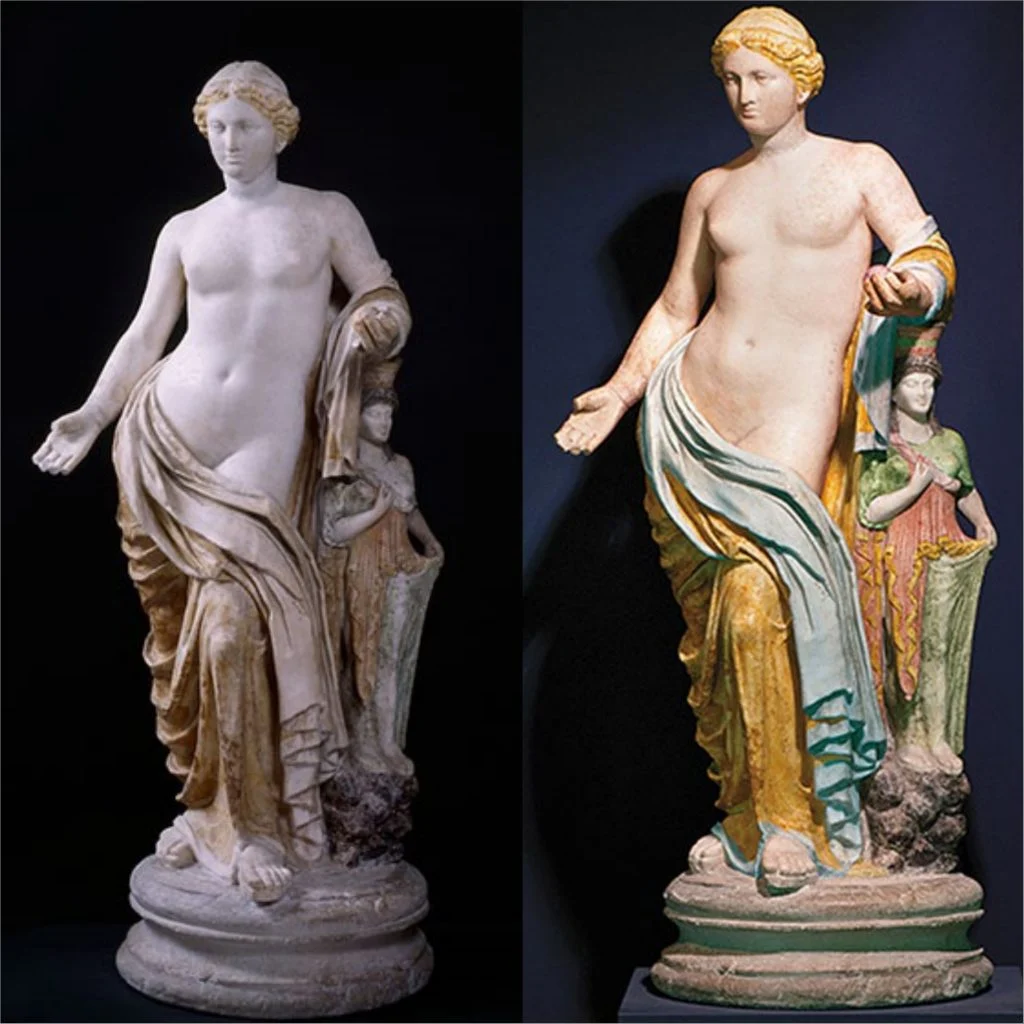
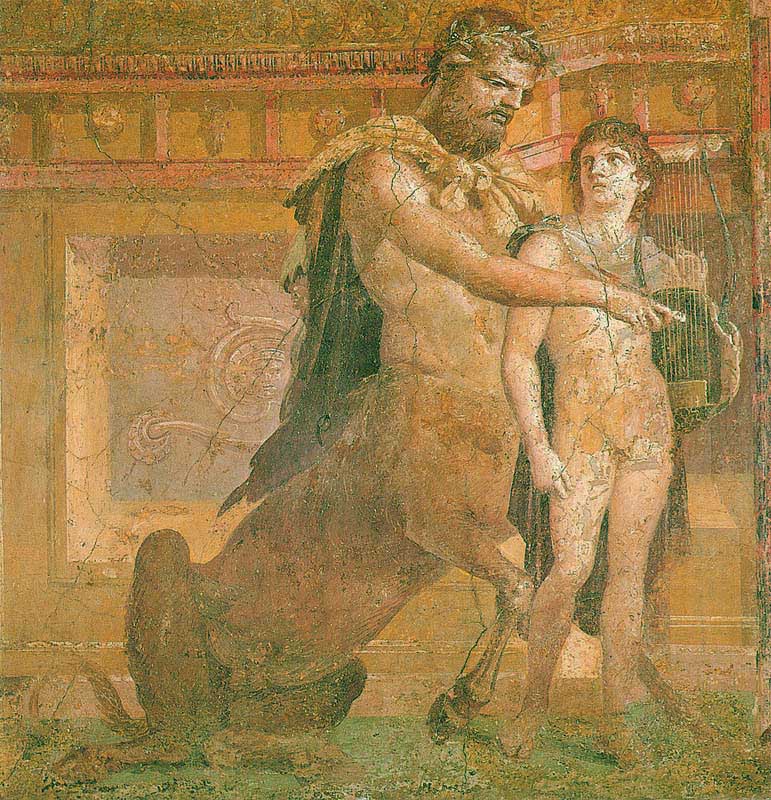

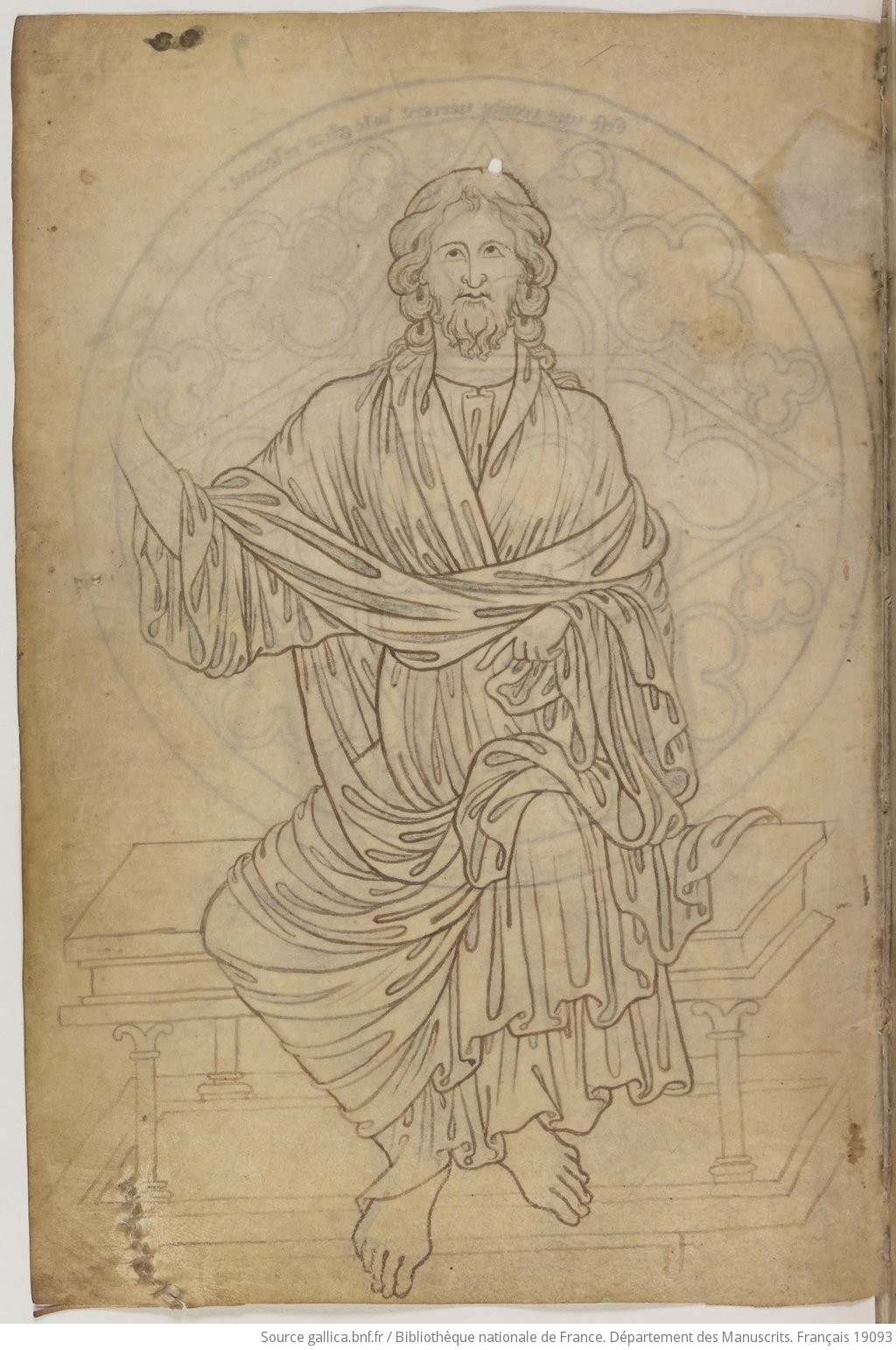

.jpg)
.jpg)